I get asked this question at least twice a month: "We just hired a Product Ops lead. What should they actually do?"
My answer used to start with theory. Similar to the agile product operating model. All true, all important. But I have learned that what leaders need first is a clear picture of what good Product Ops work looks like.
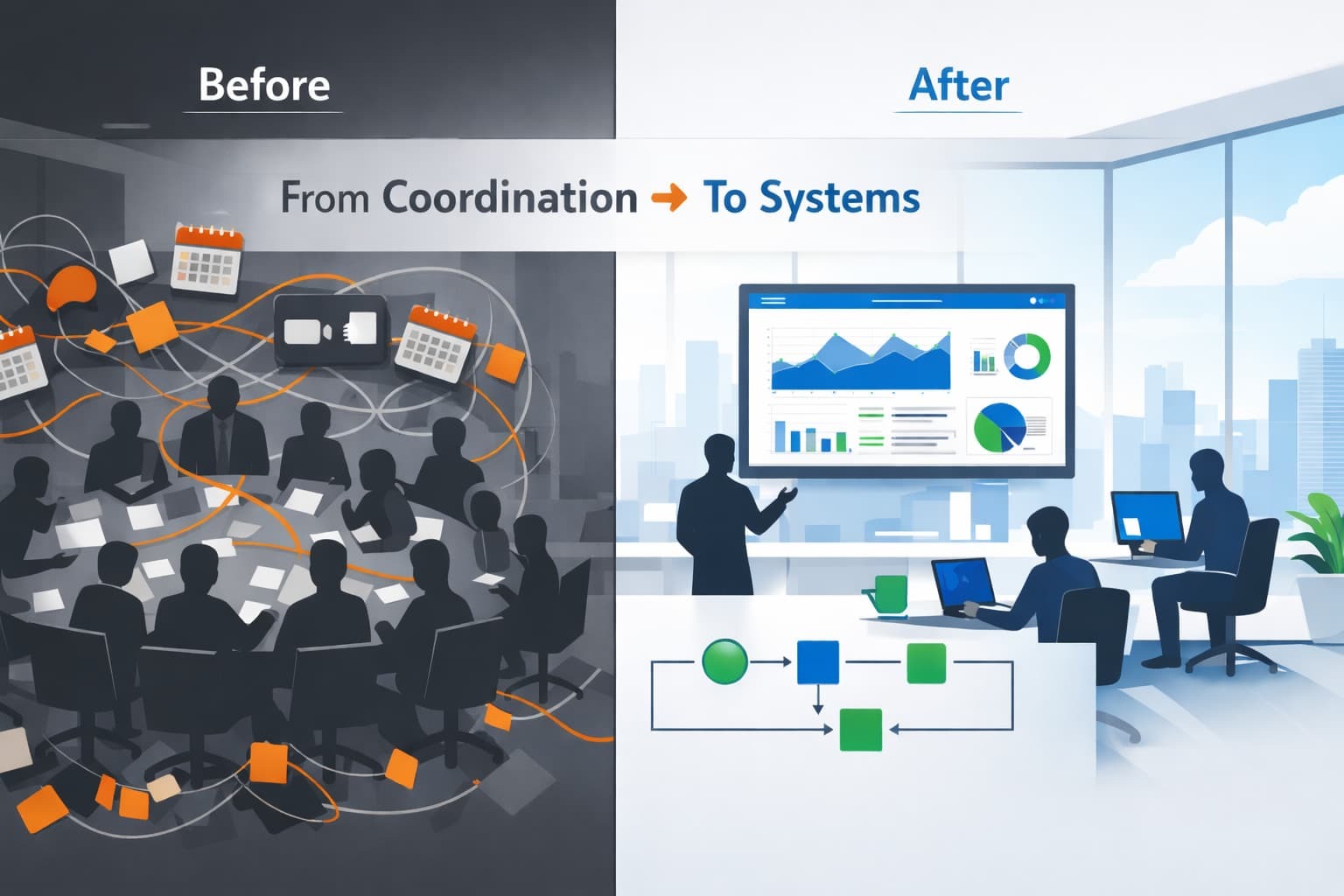
To me, the best Product Ops work I have seen had nothing to do with meetings. It had everything to do with systems, decisions, and removing friction before it became a crisis. Here are three examples worth noting and perhaps you can use them as well.
The Decision Rights Map
A Product Ops lead at a B2B SaaS company noticed something. Product teams were spending four hours per week in a dependency sync. The meeting had 12 people. The outcome was usually the same: "We will follow up offline."
Instead of optimizing the meeting, she killed it.
She built a one-page decision rights map. It answered three questions for every cross-team decision: who decides alone, who must be consulted, and who must be informed. She ran a 90-minute workshop with Product Owners and engineering leads to fill it in. Then she posted it in Confluence / Slack.
Within two sprints, four of the five dependency syncs disappeared. Teams knew who owned what. Decisions that used to take a week now took a Slack thread.
That is high-value Product Ops work. She designed a system that made coordination unnecessary most of the time. The DORA 2024 research backs this up: high-performing organizations reduce handoff tax and decision latency by making decision rights explicit, not by adding more alignment meetings.
Now don't get me wrong, there are plenty of "meetings" (or I like to call them working sessions), where we would want to meet in-person and converge on ideas. That is hard to do asynchronously, but dependecy updates have an element that can cater to offline coordination.
Source: DORA 2024 Report
The Platform Adoption Dashboard
A platform team at a fintech company built an internal developer portal. Adoption was stuck at 18 percent. Leadership wanted weekly status reports on why.
The Product Ops lead took a different approach. She did not write reports. She built a self-service dashboard that showed three metrics: time-to-first-deploy for teams using the portal, time-to-first-deploy for teams not using it, and NPS from internal customers.
The data told the story. Teams using the portal were deployed in 2.3 days. Teams not using it took 8.7 days. NPS was +62.
Leadership stopped asking for status reports. They started asking platform teams how to get the other 82 percent onboarded faster which is the right question.
This is what Team Topologies calls reducing cognitive load for stream-aligned teams. Platform teams are product teams serving internal customers. Product Ops should treat them that way: measurable outcomes, clear value props, and real customer feedback loops.
Source: Team Topologies
The Outcome Hypothesis Template
A Product Ops person at an e-commerce company inherited a 400-line roadmap. It was really a to-do list disguised as a "strategy". Every item seemed to be an output. "Build recommendation engine." "Add social login." "Redesign checkout."
She did not rewrite the roadmap. She gave teams a template to reframe each item as an outcome hypothesis.
The template had four fields:
- Problem: What customer or business problem are we solving?
- Hypothesis: If we do X, we expect to see Y behavior change.
- Evidence needed: What metric will prove or disprove this hypothesis?
- Kill criteria: Under what conditions do we stop investing in this?
Teams filled it in. Half the roadmap items could not be completed without making assumptions visible. A quarter of the roadmap got killed in the first planning session because no one could articulate the problem being solved.
The roadmap went from 400 lines to 60 hypotheses. Lead time from idea to deployed experiment dropped from 11 weeks to 4 weeks.
That is Product Ops designing systems that make better decisions easier. It is also what the DORA research shows: elite teams couple fast cycle times with high-quality decision-making. Slow is not careful. Slow is usually unclear.
What to Stop Doing
If you are running Product Ops, here are four things to stop doing this quarter.
Stop scheduling cross-team syncs as the default response to a coordination problem.
Meetings are not systems. If you schedule a sync to solve a problem, you have now institutionalized the problem as a recurring meeting. Ask instead: what decision rule, interface contract, or self-service tool could make this coordination unnecessary?
Oh and also could simply be the teams are not organized well against product streams.
Stop compiling status reports that no one reads.
If your Product Ops lead spends more than two hours per week summarizing progress for leadership, your transparency system is broken. Build dashboards. Automate the update. Make the work visible in real time. Leaders should be able to see what is blocked without asking a human.
Stop measuring Product Ops by activity instead of outcomes.
Meetings facilitated, decks created, workshops run. These are inputs. The right measure is this: are product teams making better decisions faster? Track time-to-decision, not coordination volume.
Stop becoming a proxy Product Owner.
If your Product Ops lead is making prioritization decisions, attending Sprint Planning, or "representing the business," you no longer have an Ops role. You have added a layer between Product Owners and their teams. That is bureaucracy, not enablement.
Do This Instead
Product Ops exists to reduce the transaction cost of delivering outcomes. Not to coordinate people. Not to facilitate alignment. To design systems that make good decisions cheaply and fast.
Here is how you know if you are doing it right. Ask your Product Ops lead: "What decision did a product team make faster this month because of your work?"
The DORA research and Team Topologies frameworks are not theoretical. They describe what actually works.
High-performing organizations reduce cognitive load, shorten feedback loops, and make decision rights explicit. Product Ops should be the role that designs those systems, not the role that runs more meetings to compensate for their absence.
If your Product Ops role is spending 70 percent of its time in coordination meetings, it is not fixing the system. It has become part of the problem you hired them to solve.
Start with one thing. Pick one recurring coordination problem. Ask your Product Ops lead to build a system that eliminates the need for the meeting instead of optimizing the meeting itself.
That is the work. Take small steps; progress over perfection.