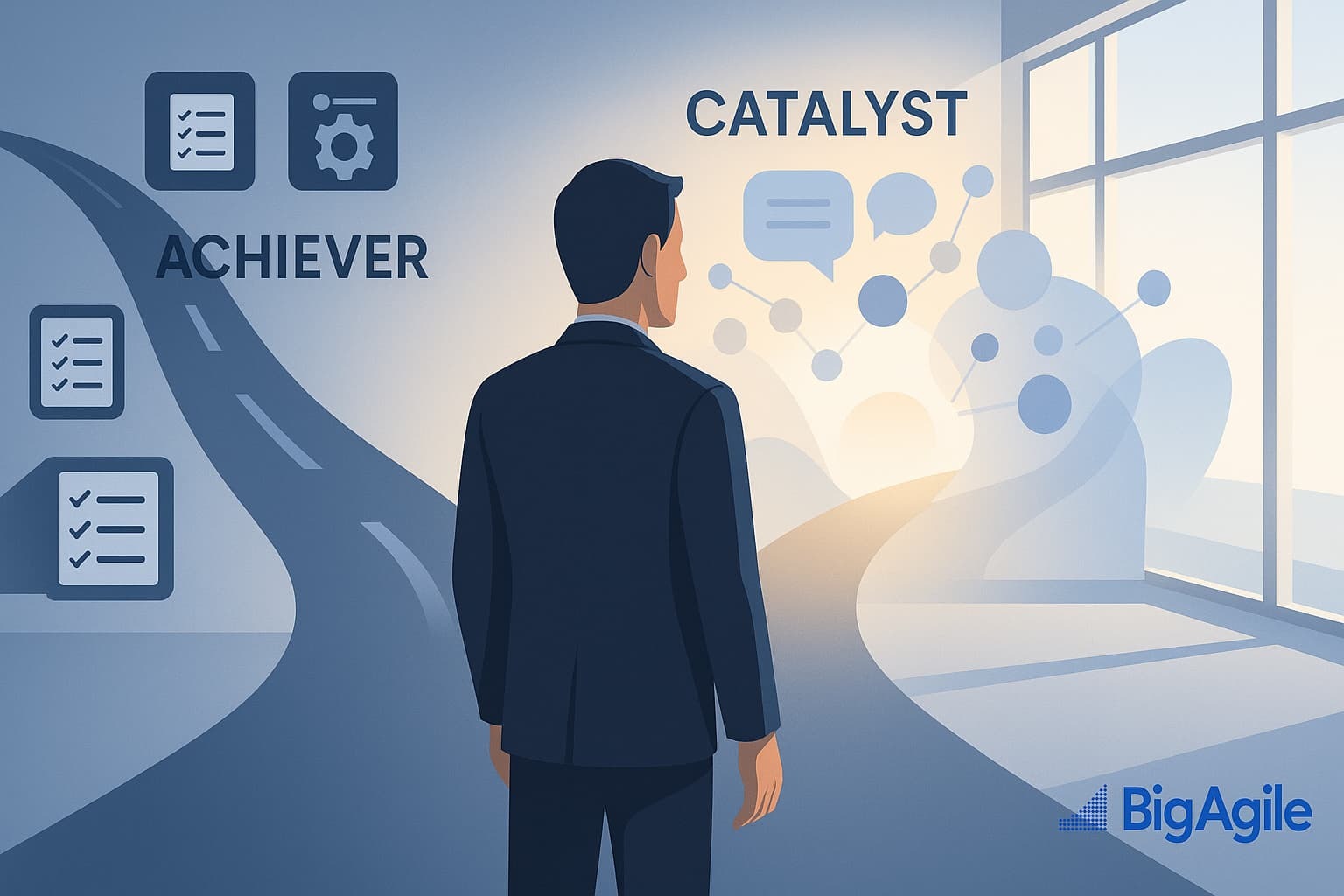
If you’ve been following along this week, we’ve been exploring why so many leaders plateau at the Achiever level, and why that becomes a ceiling when uncertainty hits. Today, we shift gears into a more practical mode. Let’s talk about the leadership inflection point that determines whether an organization can truly become agile:
The jump from Achiever → Catalyst.
This transition is where agility stops being a team-level practice and becomes a leadership-level capability. It’s also the hardest shift in a leader’s career because it requires unlearning habits that once made you successful.
The Five Levels of Leadership Agility (Quick Review)
Research by Joiner & Josephs highlights five distinct levels of leadership that determine how a person perceives change and responds to complexity:
1. Expert
“I’ll handle it myself.”
Relies on expertise
Solves problems personally
Struggles with ambiguity
2. Achiever
“Let’s hit the goal.”
Plans, drives, delivers
Strong execution
Linear and outcome-focused
3. Catalyst
“Let’s shape this together.”
Sees systems and relationships
Facilitates collaboration and learning
Encourages autonomy and experimentation
4. Co-Creator
“Purpose guides our actions.”
Leads with shared vision
Encourages distributed decision-making
High emotional intelligence
5. Synergist
“Anything is possible here.”
Operates from a place of emergence
Helps groups transcend individual viewpoints
Builds transformative outcomes
Every level has value. But when it comes to navigating uncertainty, only levels 3–5 are truly adaptive. And most organizations never get past level 2.
The Achiever → Catalyst Shift: The Real Inflection Point
This is where the evolution happens.
Achiever leaders succeed through clarity, plans, performance, and personal drive. They are excellent at managing predictable environments.
But unpredictability breaks Achiever habits. Markets, teams, and technology, none of them follow linear plans anymore.
A Catalyst leader can flex. They invite new perspectives, navigate conflicting stakeholder needs, and create space for learning rather than enforcing certainty.
Here’s the simplest difference:
Achiever: “I need to drive the result.”
Catalyst: “I need to create the conditions for results.”
One pushes. The other enables.
One directs. The other invites.
It seems small. It is not.
Practical Tools to Make the Shift
Below are the tools and behaviors I teach in leadership workshops to help leaders step into Catalyst mode.
1. The Reframing Questions Set
Achievers ask:
“What’s the plan?”
“What are the tasks?”
“What’s the deadline?”
Catalysts ask:
“What problem are we really solving?”
“Who’s affected and how do we include them?”
“What assumptions might be wrong?”
“What would learning look like here?”
“What’s the smallest next step we can test?”
A Catalyst isn’t abdicating responsibility; they’re expanding the aperture of thinking.
2. Facilitating vs. Directing
This is the most visible shift.
Achiever behaviors:
Assigning work
Telling the team what the solution should be
Running meetings centered on updates
Expecting alignment upfront
Catalyst behaviors:
Framing purpose and outcomes
Asking high-quality questions
Guiding healthy conflict
Drawing out diverse perspectives
Helping the team decide, not deciding for them
I often remind leaders: Facilitation is not passive. It’s active leadership without control.
3. Role Clarity in Complex Adaptive Systems
In a predictable system, roles define tasks.
In a complex system, roles define boundaries.
Catalyst leaders clarify:
What decisions teams own
What decisions leadership owns
Where alignment is needed
Where autonomy is required
This prevents the two biggest killers of agility: micromanagement and abdication.
Teams don’t need hands-on control, but they do need clear space to operate.
Real-World Example (Straight From the Classroom)
I was coaching a large product group where the Director kept inserting herself into every design discussion. Not because she wanted to micromanage, but because she thought her expertise was “helping the team move faster.”
In reality, the team slowed down every time she joined. They deferred decisions, waited for her approval, and second-guessed themselves.
We worked on a simple Catalyst experiment:
Instead of jumping in with solutions, she started meetings by saying: “I’m here to support. What do you all need from me today?”
The team stepped into the space.
Decision-making sped up.
Ownership went up.
She worked less while the team delivered more.
That’s Catalyst leadership in action.
Catalyst vs. Achiever: Spot the Difference
Here’s a practical checklist you can use immediately:
If you’re a Catalyst leader, your conversations sound like…
“What’s emerging that we should pay attention to?”
“What outcome matters most right now?”
“Who else needs a seat at this conversation?”
“How do we learn faster than the market?”
“What’s the smallest safe experiment we can run?”
“What are we assuming that might not be true?”
Catalysts unlock agility by unlocking thinking.
If you’re still in Achiever mode, you’ll notice these symptoms…
You’re in too many meetings.
Your team waits for you to make decisions.
You feel frustrated that people aren’t “moving fast enough.”
You rely heavily on execution metrics but rarely on learning metrics.
You feel responsible for solving problems you don’t actually own.
You get pulled down into tasks instead of staying at the outcome level.
Achiever mode isn’t bad; it’s just incomplete for the world we are leading in now.
Why This Matters (And What’s Coming Friday)
The jump to Catalyst is the doorway to organizational agility.
It’s where leadership shifts from managing work to shaping context.
Where teams move from compliance to creativity.
Where uncertainty becomes fuel instead of friction.
On Friday, we’ll expand this into a broader playbook: the seven repeatable behaviors Agile leaders use to outlearn the market.
For now, reflect on one question: “Where can I shift from driving outcomes to creating conditions?”
That’s where agility actually begins. Some of us (like me) learn that the hard way.