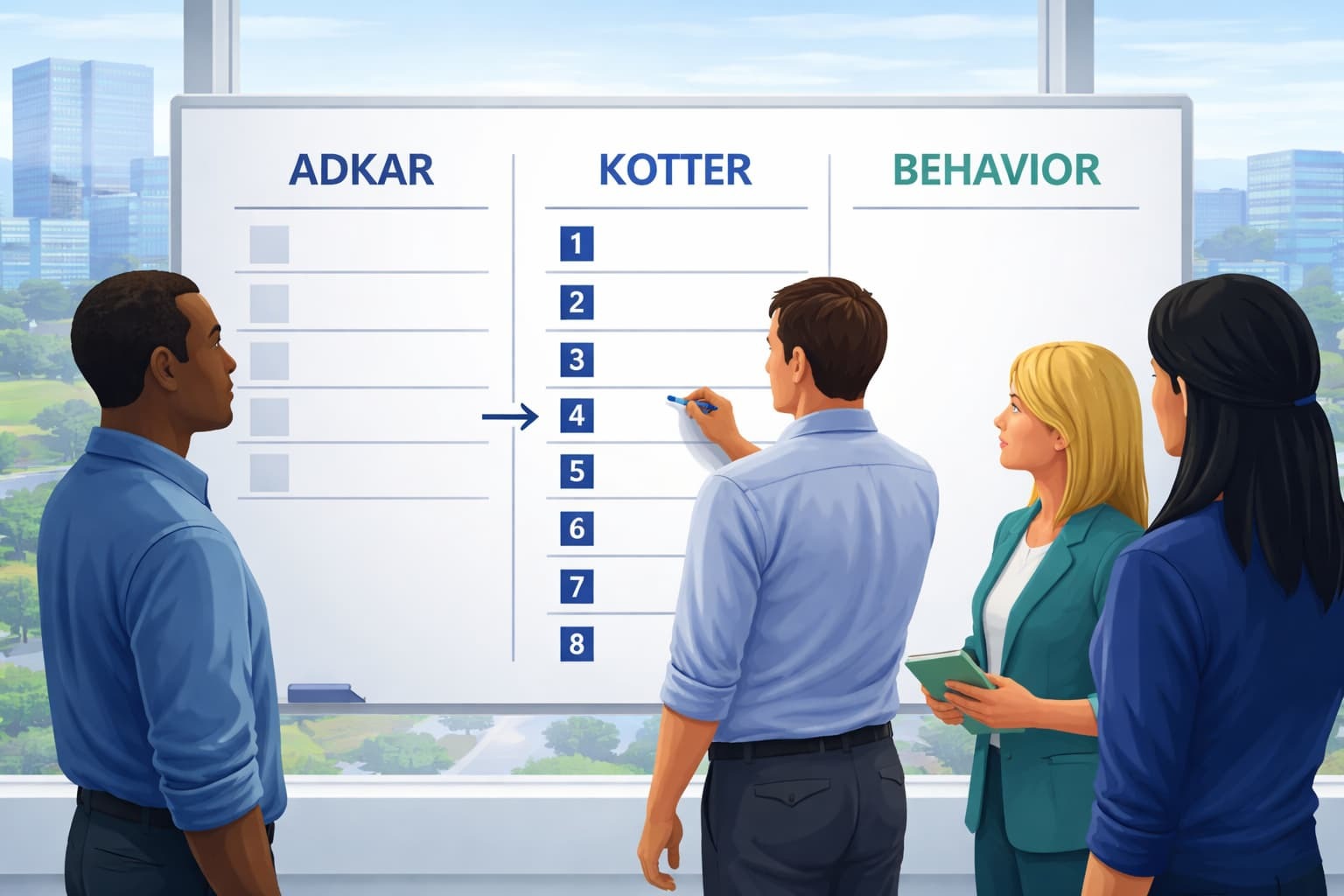
Most transformation frameworks were built for a world that no longer exists. A world with stable leadership, co-located teams, and one big change initiative at a time. Modern product organizations do not look like that. They have distributed teams spread across time zones, a new tool landing in Slack every few weeks, and leadership that sometimes turns over faster than a sprint cycle.
That does not mean the frameworks are broken. It means you have to know how to apply them under these conditions. Two in particular, Prosci's ADKAR model and John Kotter's 8-Step Process, are still the most field-tested change tools available. The problem is that most leaders use only the early stages of each and then wonder why nothing holds.
This post maps both frameworks to the real conditions product organizations face in 2026, with a focus on the three friction points that kill adoption faster than anything else: tool overload, leadership churn, and distributed teams. There is also a Monday morning checklist at the bottom. Take what is useful and go.
A quick reminder of what each framework actually does
ADKAR is an individual-level change model. It describes the five conditions a person needs in order to change and sustain new behavior: Awareness of the need to change, Desire to participate, Knowledge of how to change, Ability to demonstrate the new behavior under real conditions, and Reinforcement that keeps it going after the novelty wears off. The model was developed by Prosci and remains one of the most practical lenses available for understanding why specific people are stuck at specific stages.
Prosci ADKAR Model: https://www.prosci.com/adkar
Kotter's 8-Step Process is an organizational-level model. It describes the sequence of conditions a large group needs to move through for a transformation to take root: establish urgency, build a guiding coalition, form a vision and strategy, communicate that vision, remove barriers, generate short-term wins, sustain acceleration, and anchor changes in culture. It was built on decades of research into why transformation efforts fail, and the most common failure point is stopping at step six.
Kotter's 8-Step Process: https://www.kotterinc.com/8-steps-process-for-leading-change/
Used together, these frameworks are complementary. Kotter gives you the organizational choreography. ADKAR gives you the individual lens. Every person on your team is somewhere in the ADKAR journey. Your job is to know where, and to design the organizational environment to support the next step.
Friction point one: tool overload
The average product team in 2026 is running somewhere between eight and fourteen tools simultaneously. Jira, Confluence, Slack, Figma, Notion, GitHub, a data dashboard, a roadmap tool, and three things someone installed last quarter that nobody has removed. Every new way of working you introduce lands in that same pile.
Through an ADKAR lens, tool overload is a Knowledge and Ability problem. People may have Awareness and even Desire. They attended the training. They said yes. But when they sit down to do the thing, they cannot figure out which tool to use, where the new process lives, or how it connects to what they were already doing. That is not resistance. That is cognitive load.
Through a Kotter lens, tool overload is a barrier that has to be removed before you move to step six. If you skip that removal and start celebrating short-term wins, you are celebrating compliance theater, not behavior change.
What to do: Before introducing a new practice or tool, map where it lands in the team's existing workflow. Pick one place it shows up. Make that place obvious. The new behavior has to be easier to do than the old one, not one more thing stacked on top.
Friction point two: leadership churn
Nothing kills a transformation faster than the champion leaving. You know how this goes. A director spends eighteen months building genuine momentum. Real behavioral changes. Teams shipping differently. Then she takes a role at another company, and six months later the org has quietly reverted to everything it was before she arrived.
Kotter's framework names this directly. Steps seven and eight, sustaining acceleration and anchoring in culture, exist precisely because transformation is never finished when one person leaves. The goal is to make the new way of working structural, not personal. If the change lives in one person's calendar and communication style, it is not anchored. It is borrowed.
Through an ADKAR lens, leadership churn exposes whether Reinforcement was ever real or just positional. If the only reinforcement mechanism was a leader who believed in the change, then Reinforcement was fragile from the start.
What to do: Identify at least two people outside the leadership layer who can sustain the coaching rhythm. Make the new behaviors visible in team-level metrics, not just in leadership communication. If the only signal of progress is a leader saying it is going well, you do not have structural reinforcement yet.
Friction point three: distributed teams
Distributed teams break every assumption that traditional change management makes about proximity. The informal hallway conversation that reinforces a new behavior does not happen on Slack the same way. The energy of a shared kickoff dissipates across time zones. The cultural cues that tell a co-located team "this is how we do things here" are much harder to transmit when half the team is in a different country.
Through an ADKAR lens, distributed teams have a Desire and Reinforcement problem that compounds over time. People in the same physical space can read each other's commitment to a change. Distributed teams cannot. Without visible reinforcement signals, the Desire to sustain the change decays, often silently, until someone checks in and discovers the behavior stopped three sprints ago.
Through a Kotter lens, distributed teams require a more intentional guiding coalition. You cannot rely on proximity to spread cultural change. You need explicit coalition members in each location or time zone who are actively modeling the new behavior and creating local feedback loops.
What to do: Build your guiding coalition with geographic distribution in mind. At least one person per time zone cluster who believes in the change and will model it publicly. Create shared visible artifacts, a team board, a metrics wall, a weekly written check-in, that make the new behavior legible across distance. Reinforcement has to be designed for asynchronous environments, not assumed from in-person ones.
Mapping it together: goals to daily behaviors
Here is where the two frameworks do their best work together. Kotter operates at the level of organizational goals and transformation stages. ADKAR operates at the level of individual daily behavior. The gap between those two levels is where most transformations get lost.
A Kotter step three goal might be: "Shift our operating model to outcome-based team structures." That is a good goal. But it does not tell a senior engineer anything about what to do differently tomorrow morning. ADKAR closes that gap. The question is not "did we communicate the vision" (Kotter step four). The question is whether each individual person has Awareness, Desire, Knowledge, Ability, and Reinforcement for the specific behaviors the new operating model requires.
In practice, this means for every Kotter stage you are working through, you should be able to name the observable daily behaviors you are targeting and then assess where each team or person sits in the ADKAR journey for those specific behaviors. That combination is what turns strategy into something a team can actually feel on a Tuesday morning.
Do This Monday Morning
Pick one change initiative your organization is currently running. It can be an agile transformation, an AI tool rollout, a new operating model, anything. Then work through this checklist before your next planning conversation about it.
Monday Morning Adoption Checklist

Initiative: ________________________________

ADKAR CHECK (per person or team)
[ ] Can you name the specific daily behaviors
    this change requires? (If not, start here.)
[ ] Does each person know WHY this change
    is happening and what it costs to not change?
[ ] Do they WANT to? Or are you assuming
    training created desire?
[ ] Can they actually DO the new behavior
    under real conditions, not just in a workshop?
[ ] Is the environment REINFORCING the behavior,
    or are you still doing it manually?

KOTTER CHECK (organizational level)
[ ] Is urgency still real and visible,
    or has it faded since the kickoff?
[ ] Is your guiding coalition still active,
    or has it become a steering committee
    that meets once a month?
[ ] Have you generated at least one
    visible, unambiguous short-term win?
[ ] Are steps 7 and 8 on your roadmap,
    or did you stop at the early wins?

THREE FRICTION CHECKS
[ ] Tool overload: Is the new behavior
    easy to find and do inside existing workflow?
[ ] Leadership churn: Would this survive
    if your top champion left next month?
[ ] Distributed teams: Does every time zone
    cluster have a coalition member modeling
    the change locally?

ONE THING TO DO THIS WEEK
The lowest ADKAR stage you identified: _______
One action to address it: ___________________
If that checklist surfaces more red than green, that is useful information. It means you know where your leverage is. The goal is not a perfect score. The goal is honest visibility into where the change is fragile, so you can address it before organizational gravity does.
Training is a door. Reinforcement is what is on the other side. Most organizations fund the door and forget the hallway. The checklist above is a way to keep checking whether anyone is still walking through it.