Most delegation decisions make themselves. Nobody convenes a meeting about whether AI can format a commit message, and nobody needs a framework to know that unattended production deploys are a bad first experiment. The decisions that stall are the ones in the middle, where the task is useful enough to want automated and consequential enough to make you hesitate.
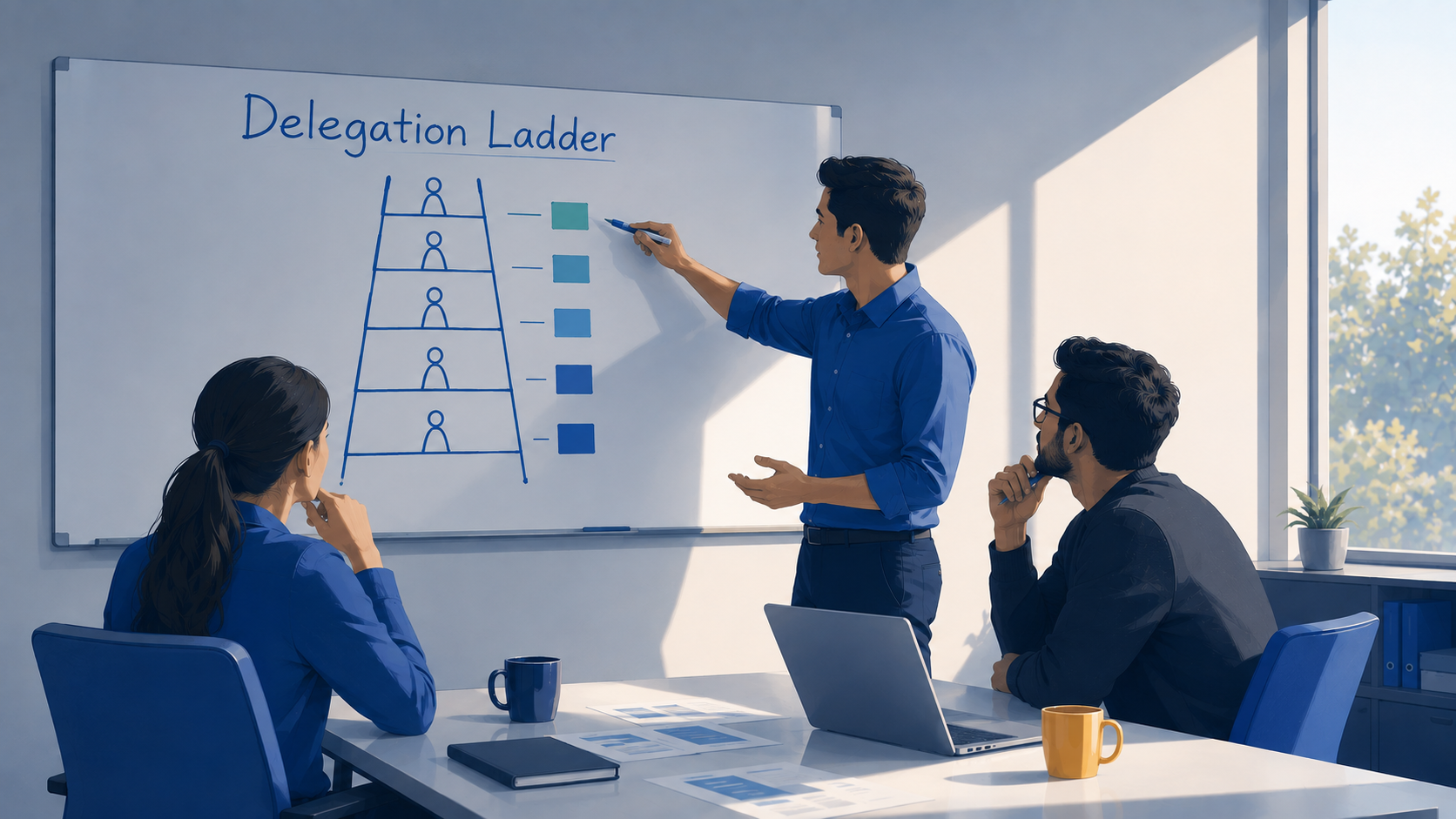
Monday’s episode walked through the Delegation Ladder and the survey data behind it: five rungs, from draft at the bottom to act with monitoring at the top. Draft, assist, recommend, act with review, act with monitoring. The rung is not set by how good the tool is. It is set by what it costs you when the tool is wrong, and whether you would ever find out.
That works cleanly at the extremes, but how about in the middle?
The middle is where you actually live
Consider three tasks a product team might hand to AI this quarter. A pull request that touches authentication. A customer-facing release note. An inbound support ticket routed and assigned a priority.
None of the three is obviously safe, and none is obviously reckless. Each one is being done by someone on your team right now, at whatever rung that person privately chose. The problem is not that they chose wrong. It is that three people chose three different things and nobody compared notes.
Four questions that place a task
Monday's single question is the compressed version: if this is wrong and nobody catches it, who finds out first, and how? That question resolves most tasks in about fifteen seconds. When it does not, it is because it is bundling four separate things. Pull them apart.
1. What does it cost when it is wrong?
Not the average cost. The cost of the worst plausible version. A wrong priority on one support ticket costs an afternoon. A wrong priority on the one ticket that was a security report costs considerably more, and the average of those two numbers describes neither.
Cost is also not only the incident. It is the review time you spend catching near-misses, which is where a lot of AI-assisted work quietly relocates its expense. We covered that pattern in the hidden cost of AI-generated code.
2. Can you take it back?
A draft you delete costs nothing. An email that has been read cannot be unread. Ask what the actual undo looks like, in steps, and whether the undo restores the situation or just stops it getting worse.
Reversibility is the same property that makes a small experiment safe to run, and it is worth accounting for when sizing. If you have not thought about blast radius in these terms before, shrinking a bet without shrinking the goal covers the sizing logic.
3. How fast would you know?
Put a number on it. Minutes, hours, days, or a quarter. A test suite answers in four minutes. A customer answers in three weeks. A colleague reading their own name in a document you sent answers immediately, and by then it is no longer helpful.
4. Would you know at all?
This is the question teams skip, and it is the one that decides most placements. Speed of detection is meaningless if detection is not happening. A weekly report nobody opens is not a signal. A dashboard that has been green for six months because nothing writes to it is not a signal either.
Last week’s argument applies directly here: naming a person in the loop does not create oversight unless that person can actually stop the thing. The full version is in why human in the loop keeps failing as a control.
The tool
Run this with the people who own the task. It takes about 10 minutes per task, and the output is a single line you can put somewhere visible. You can download it here.
PLACING A TASK ON THE DELEGATION LADDER
Run with the team that does the task. Ten minutes.

TASK: _______________________________________
Who does it today: __________________________
Roughly how often: __________________________

1. COST WHEN WRONG
   The worst plausible version, not the average.
   Answer: _________________________________
   Circle one:  low   medium   high

2. REVERSIBILITY
   Write the actual undo, in steps. If there is
   no undo, write "none."
   Answer: _________________________________
   Circle one:  easy   partial   none

3. SPEED OF DETECTION
   How long until someone would know. Put a
   number on it.
   Answer: _________________________________
   Circle one:  minutes   hours   days   never

4. CERTAINTY OF DETECTION
   Name the mechanism and the person. "Someone
   would probably notice" is a no.
   Mechanism: ______________________________
   Person: _________________________________
   Circle one:  automatic   manual   none

PLACEMENT
Every answer sets a ceiling. The task sits at the
lowest ceiling any answer gives it.

  COST WHEN WRONG
    low 5      medium 4    high 3
  REVERSIBILITY
    easy 5     partial 4   none 3
  SPEED OF DETECTION
    minutes 5  hours 4     days 3    never 2
  CERTAINTY OF DETECTION
    automatic 5   manual 4    none 3

This is deliberately conservative. Four middling
answers land at rung 4, not rung 5, because
nothing about a middling answer earns unattended
work. To go higher, do not argue with the table.
Improve one answer, usually certainty, and run it
again.

The table scores the task as it runs today, not
the task you intend to build. That is why the
placement line below has two fields.

Rung today: ____   Rung it should be: ____
One sentence on why: ________________________

DONE WHEN: the rung is written where the team
can see it and one person has said it out loud
in a team event.
A worked example, where the answers disagree
Take the support ticket. An AI reads inbound tickets, assigns a priority, and routes them to a queue. No human touches it before it lands. That is rung five behavior, and it usually arrives as a feature somebody switched on rather than as a decision somebody made.
TASK: AI assigns priority and routes inbound tickets
Who does it today: nobody, the tool does it
Roughly how often: a few hundred a week

1. COST WHEN WRONG
   Most mis-priorities cost an afternoon. The
   bad one is a security report sitting in a P3
   queue for a week.
   Circle one:  low   medium  (HIGH)

2. REVERSIBILITY
   Undo: re-prioritize and re-route. Two clicks.
   The ticket recovers. The elapsed time does
   not.
   Circle one:  easy   (PARTIAL)   none

3. SPEED OF DETECTION
   When the customer escalates. Three to five
   days, and only for customers who escalate.
   Circle one:  minutes  hours  (DAYS)  never

4. CERTAINTY OF DETECTION
   Mechanism: none. Nothing watches for a ticket
   that was under-prioritized and went quiet.
   Person: none named.
   Circle one:  automatic   manual   (NONE)

PLACEMENT
Rung today: 5    Rung it should be: 3
One sentence on why: reversible on paper, but
nothing tells us when to reverse it.
Reversibility is the only answer arguing for leaving it alone, and it caps at rung 4. Cost, speed, and certainty all cap at rung 3, so the task lands at 3. Certainty is the one doing the real work: even if the ticket were instantly reversible, nothing would tell you when to reverse it.
Which answer wins
When the four disagree, the lowest ceiling wins. That is worth a sentence of justification rather than a shrug, because two of the four do most of the work.
Certainty of detection beats reversibility. Something you can undo but will never notice is not reversible in any way that helps you. The undo exists in the tooling and never fires in real life. Treat "no mechanism, no person" as if the task were irreversible, because operationally it is.
Cost beats speed. A cheap failure you find out about slowly is survivable. An expensive failure you find out about quickly is still expensive. Fast detection reduces how long a problem runs, not how much the problem was worth.
When the team disagrees about the answer
Two people will answer question one differently for the same task, because they are imagining different failures. One is picturing the typical Tuesday and the other is picturing the worst week of last year. Both are answering honestly.
Resolve it by making the failure specific rather than arguing over the adjective. Ask each person to describe the actual incident they have in mind, in one sentence, with who is affected. Most disagreements about risk turn out to be disagreements about which story you are pricing. Once both stories are on the table, the group can usually agree that the worse one is plausible enough to plan for, or agree that it is not.
If it still does not resolve, the person who carries the consequence decides. Not the person who owns the tool, and not the person who is loudest about velocity. Whoever gets the call at two in the morning when it goes wrong has the final say on where it sits.
How often to revisit
A placement is a decision with a shelf life. Two things change it. Detection improves, letting the task move up, or the task starts touching something it did not touch before, which moves it down.
Put the review somewhere you already meet rather than creating a new event for it. Once a quarter is enough for most teams, and the prompt is one line: has anything we automated started reaching a customer, a regulator, or another team without a person in between? If yes, that task needs to be placed again.
The move most teams miss
Placing the ticket task at rung three means a human triages every inbound ticket, which nobody wants and which is why it got automated in the first place. There is a third option, and it is usually the better one.
Instead of lowering the rung, add the signal. An alert on any ticket that has sat unassigned or untouched past its priority threshold turns question four from "none" to "automatic." With that one change the same task sits at rung five honestly, because now something actually watches it. Lowering the rung is still the right move when you cannot add a signal quickly, and it is the safer default while you work out whether you can. The order is what matters: ask what would tell you first, and drop the rung if the answer is nothing you can build this month.
That is the difference between governance that slows a team down and governance that lets it move. The smallest version that earns trust is usually a signal rather than an approval, which is the argument in minimal viable governance.
Write it where people can see it
A rung held privately is a preference. Three people on a team will hold three different ones for the same task, and none of them will know, which is exactly the state this whole exercise exists to end.
Put the rung next to the task. In the runbook, the team charter, the channel topic, wherever your team actually looks. Then say it out loud once in a team event, so the decision has a witness and a date.