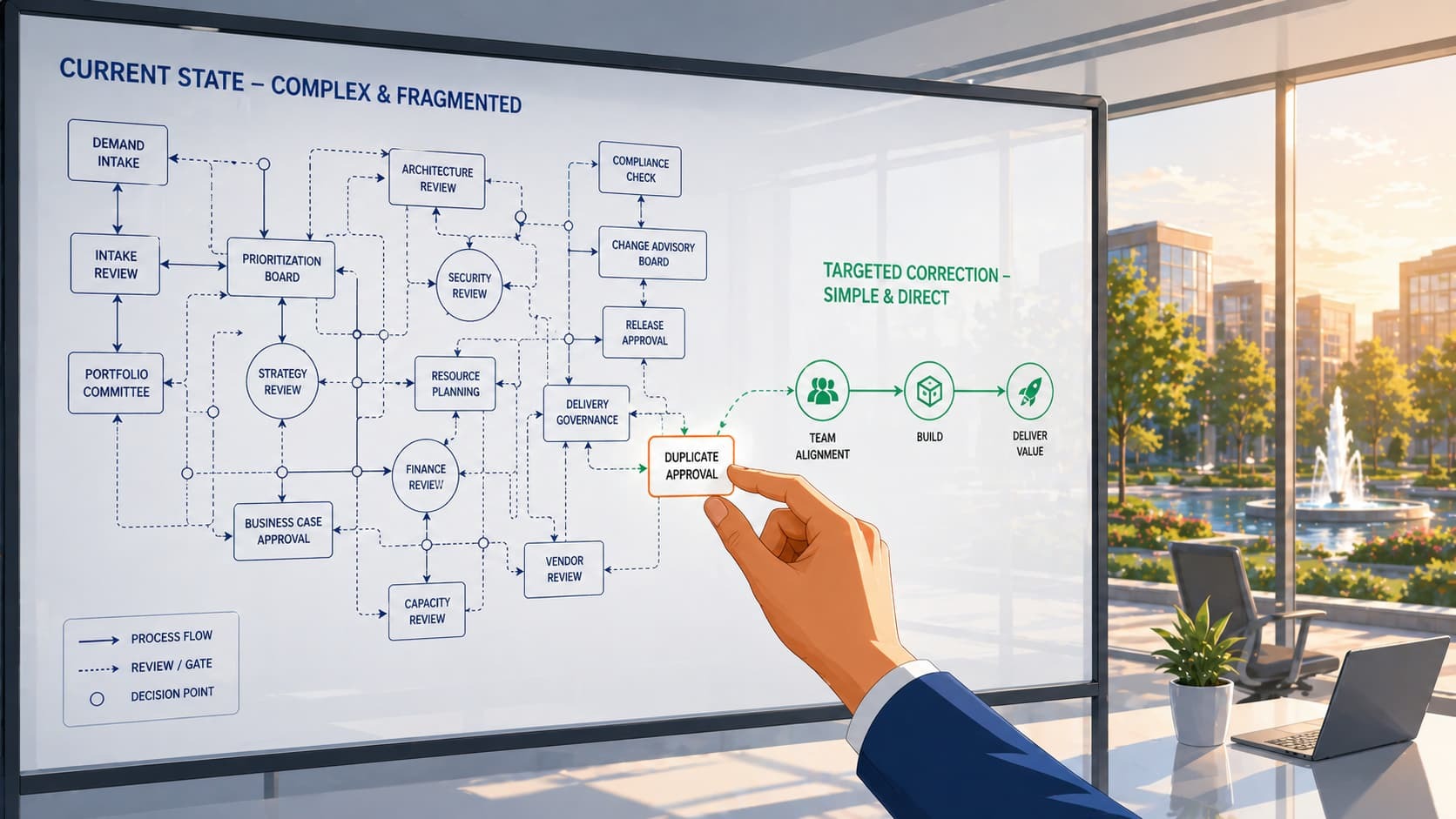
You're sitting in a PI planning event. It is day two. The room has been at it for twelve hours across two days, and the teams are negotiating dependencies on a board that looks like a conspiracy theorist's bedroom wall. Somewhere around hour nine, you realize the plan everyone is building will be outdated before the first Sprint is over. But nobody is going to say that out loud, because this ceremony cost too much to question.
If you have had that moment, the one where you know the process is not helping but you cannot find the words to say it, this post is for you. Specifically, it is for Scrum Masters, coaches, and delivery leads who can see the problem but need specific, observable patterns and language to bring the conversation to leadership.
The hard truth about scaling frameworks
Scaling frameworks solve real problems. When teams are stepping on each other and releases are breaking, structure helps. But structure has a shelf life. The coordination layer you added three years ago to reduce chaos may now be the primary source of slowdown, not because the framework was wrong, but because the problem changed and the framework did not.
The Scrum Guide puts it simply: Scrum is founded on empiricism and lean thinking. Lean thinking reduces waste and focuses on the essentials. If you are not regularly asking what is essential and what is waste, your process will accumulate weight over time. Every process does. That is not failure. That is organizational gravity.
What to look for instead
The goal is not to scrap everything. It is to recognize the signal that a structure has inverted from enabler to constraint and apply a targeted correction. In Monday's video, I introduced the Earn Test: three questions you can run on any ceremony, role, or artifact. Does this remove an impediment, or does it just manage complexity we created? If we removed it tomorrow, what would actually break? Could we get eighty percent of this value with something lighter?
Below are five specific, observable patterns I see repeatedly in organizations where the scaling framework has quietly become the bottleneck. For each one, I will explain what it means structurally and what a single targeted change looks like.
Sign 1: Teams spend more time coordinating work than doing it
Pull up any team's calendar for this week. Count the hours in cross-team ceremonies, syncs, and alignment meetings. Now count the hours of uninterrupted time to build, test, and ship product. If the first number is winning, you have a coordination tax problem.
Reinertsen's research on product development flow makes the economics clear. Every coordination event carries a transaction cost. When the cadence is predictable and the cost is low, coordination is cheap and valuable. But when you stack a pre-sync, a sync, and a leadership readout on top of each other, you have tripled the transaction costs without tripling the value.
The targeted change: Audit every recurring meeting that involves more than one team. For each one, ask: did this meeting produce a decision in the last three instances, or did it only produce information? If it only produced information, replace it with an async update and give teams their hours back.
Sign 2: PI planning takes more calendar space than the delivery it supports
Two days of preparation. Two days of execution. A full day of follow-up. That is a week of calendar space to produce a plan that will shift within the first Sprint. When the planning ritual is larger than the delivery it supports, the tail is wagging the dog. This is a batch size problem. Large, infrequent planning events feel thorough, but every assumption baked into a ten-week plan accumulates risk while it sits unvalidated.
The targeted change: Cut your planning horizon in half and run planning twice as often at half the duration. You will quickly discover which parts of the big ceremony were actually producing decisions and which were theater. Keep the decisions. Cut the theater.
Sign 3: Nobody can name a decision the governance layer made faster
Ask your leadership team this question: "What specific delivery decision was made faster last quarter because of our governance process?" If the room goes quiet, your governance may not be keeping pace with the speed the business actually requires. Structures that started as decision accelerators often morph into approval queues, adding latency without anyone noticing the drift.
Hamel's research on bureaucratic drag shows the pattern clearly. Every new challenge in a bureaucracy tends to spawn a new oversight function, a new review board, a new required report. Each one makes sense on its own. But what it all adds up to is that decision-making slows down until the cost of the structure exceeds the value of the coordination.
The targeted change: Pick one decision type that currently requires governance approval and push the decision authority to the team for one quarter. Measure whether speed improves and quality holds. If it does, that governance layer was adding latency without adding value.
Sign 4: The Release Train Engineer's primary output is status reports
The RTE role was designed to remove impediments and improve flow across teams. That is valuable work. But in many organizations, the RTE spends eighty percent of their week compiling dashboards, chasing status updates, and preparing readouts for leadership. When that happens, the role is no longer serving the teams. It is serving the management layer above the teams. And the teams now carry an extra dependency without getting any impediment removal in return.
Here is the real talk on this one: if your RTE's calendar is dominated by reporting, you do not have an RTE. You have a project coordinator with a scaled Agile title. That is not a criticism of the person. It is a signal that the role has drifted from its designed purpose.
The targeted change: Ask the person in the coordination role to track their time for two weeks. Categorize every hour as either "removing an impediment for a team" or "producing information for leadership." If the ratio tilts heavily toward reporting, either automate the reporting or simplify what leadership needs to see. Free the role to do what it was built for. (Role drift is closely related to why training does not stick; the system reshapes the role faster than the training can hold.)
Sign 5: Teams have learned to game the ceremonies instead of using them
This is the hardest one to see from the outside because the ceremonies look fine. People show up, the agenda runs, the outputs get recorded. But quietly, teams have figured out how to satisfy the process without actually using it to learn or decide anything. Sprint Reviews become scripted demos. Retrospectives produce action items nobody tracks. Dependency boards get updated five minutes before the sync meeting, not because the situation changed, but because someone needs to show progress.
The Scrum Guide says inspection without adaptation is considered pointless. When teams game the ceremonies, that is exactly what you have: inspection theater with no adaptation. The LeSS community calls this out directly. Complicated organizations with many roles, processes, and artifacts are slow to adapt. When teams are gaming your process, the process has become too complicated for the value it delivers.
The targeted change: For your next Sprint Review or Retrospective, skip the standard agenda entirely. Open with one question: "What did we learn in the last two weeks that should change what we do next?" If the answer is "nothing," you have either stopped learning or stopped being honest. Both are structural problems, and both are worth exploring with the team in a safe, low-pressure setting.
Common traps when raising these signals
Framing it as anti-framework. If you walk into a leadership conversation and say "we need to descale," people hear retreat. They hear "we wasted money." Instead, frame it as efficiency: "The structure was the right call when we made it. Our teams are more mature now. The coordination overhead that was necessary three years ago is no longer proportional to our actual technical dependencies." (This companion post walks through which practices still earn their place and which do not.)
Trying to cut everything at once. Pick one category. Just one. Ceremonies are usually the easiest starting point because calendars do not lie. Run the Earn Test on each cross-team ceremony before expanding to roles and artifacts.
Making it about people instead of structures. When you identify a role that has drifted, the conversation is about rescoping the role, not criticizing the person. The redesign option is often the most powerful outcome: keep the person, rescript the responsibilities.
Try this next week
Pick one recurring cross-team ceremony. Pull up the last three instances of it. For each one, answer three questions. Did this meeting produce a decision? Could the same result have been reached asynchronously? And what is the actual cost in engineer-hours per month (people times duration times frequency)?
Write down what you find. If the meeting produced real decisions that could not have happened any other way, great; it earns its place. If it did not, you now have evidence for a conversation about redesigning or cutting it. That evidence is what turns an opinion into a proposal.
If your organization is working through this right now, whether it is descaling, improving flow, or figuring out the right amount of structure, a focused coaching conversation can help you move faster with less risk. That is what Big Agile does.
Scrum Guide 2020: scrumguides.org/scrum-guide.html
LeSS Descaling Principles: less.works
Reinertsen, The Principles of Product Development Flow
Hamel, Humanocracy
Read Next
The Five Agile Practices Worth Keeping (And Three to Retire)
If you are running the Earn Test on your ceremonies, this post applies the same lens to the practices themselves. Which ones still produce learning and decisions, and which ones have quietly become overhead?