
A pilot that stalls does not announce it. There is no meeting where somebody says this one is over. It keeps its login and its budget line, the follow-up meeting quietly stops appearing on the calendar, and six months later the honest answer to what happened to it is that nobody knows. This is a checklist for catching that before it starts, and an argument for why the gap is about people rather than about models.
Nobody had been keeping the list
Deloitte's State of AI in the Enterprise 2026 report includes fifteen interviews with senior executives and AI leaders alongside its survey. In one of them, an AI leader went looking for a list of every AI tool and model running inside their own company and could not produce one. The development had happened without systematic tracking and without centralized visibility.
That is one instance from fifteen interviews. It is not a measurement of how common the situation is, and Deloitte does not present it as one.
Deloitte, State of AI in the Enterprise 2026: the full report
I am starting there anyway, because the shape is the useful part. Something got built. Something got deployed. Nobody ever said out loud whose job it was after that. Reading that as an ownership problem rather than a model problem is mine, not Deloitte's.
Demos are built to remove friction. Real operations are made of friction, and a system that works in the demo can still die in the workflow for reasons that have nothing to do with whether the model is any good.
Access widened. Conversion did not.
The measured half of that report starts with who is in it. Deloitte surveyed 3,235 leaders, director level through the C-suite, across 24 countries, in August and September of 2025. Every organization in the sample already had AI running in daily use, and every respondent influenced, made, or oversaw AI decisions. Deloitte screened for both deliberately.
So every number below is a share of companies already doing AI rather than a share of companies generally, and that distinction does a lot of work. Deloitte also sells AI transformation services, which is true of every source in this piece.
Inside that group, Deloitte reports sanctioned AI access among workers at those organizations growing by half in a single year, from under 40% of those workers to under 60% of them. That is leaders estimating their own workforce rather than a measurement of workers.
The second half of the finding sits on a different base, so it is worth reading slowly. Among the workers who do have access, Deloitte reports fewer than 60% using AI in their daily workflow, and describes that share as largely unchanged from the year before. Access moved. Use did not.
Deployment tells a similar story. A quarter of those organizations report having moved 40% or more of their AI experiments into production so far. Watch the unit there: that is experiments deployed, not pilots that worked. A company that ran four and shipped two sits inside that quarter, and so does a company that ran ten and shipped four badly.
Deloitte also reports 54% of those organizations expecting to reach that same level within three to six months. I would hold that one loosely, and the same report supplies the reason: most respondents there expect key challenges on their priority AI initiatives to take more than a year. A lot of access, a quarter converting at any real rate, and a great deal of confidence about six months from now.
Sponsorship is not ownership
Some of you are already arguing with this, and there is data on your side. KPMG's AI Quarterly Pulse Survey for the second quarter of 2026 put a question to US-based C-suite and business leaders at organizations earning a billion dollars a year or more. It asked whether their CEO actively owns AI as a strategic business priority with clear accountability for AI-related outcomes, and two-thirds agreed or strongly agreed. Perspectives were captured between April 28 and May 25, 2026, every answer is self-reported, and the sample is a single country and large enterprises only.
The same page reports where accountability for AI-informed business decisions actually sits among that group: 34% with a named C-suite executive, 32% with the CEO or executive committee, 14% with a business unit leader, and 10% with a centralized AI governance or risk committee. Those four options do not account for everyone, and the deck does not say what the remaining tenth is.
KPMG reads that spread as a strength. Its own framing is that ownership of AI outcomes is distributed across senior leadership, anchored at the top and executed across a broader group. I read the same page as diffusion, and that reading is mine rather than KPMG's.
Both things can be true at once, and the distance between them is the entire subject. A CEO can own AI as a strategic priority while there is nobody whose actual job is running one model on a Tuesday. Especially the Tuesday it starts returning nonsense.
Strategic sponsorship sets direction and unblocks money. It clears the political path and it signs the check. It does not get woken up at two in the morning, it does not decide whether to pause the model, and it does not own the business result the pilot was supposed to move. That is a different job, and owning something is not the same as controlling it.
The five sections
Wednesday's instrument is the Pilot-to-Production Readiness Checklist. It has five sections, in this order: ownership, outcomes, decision rights, escalation, and evidence.
Nothing in the research above measures those five. They are the things I go looking for when a pilot has stopped moving, which makes this a way of thinking rather than a validated model, and I would rather say that than dress it up as science. Versions of the same idea exist elsewhere under other names, and it would not surprise me at all to find a better one.
They are loops rather than documents, which is the part that gets lost. A form filled in once and never revisited is the failure this is meant to prevent, not the goal it is aiming at. Every one of the five is a decision somebody has to make out loud, in front of witnesses.
PILOT-TO-PRODUCTION READINESS CHECKLIST
Fill this in with the pilot team and the person who
would fund production. One pilot per copy.

PILOT: _______________________________________
DATE:  _______________________________________

1. OWNERSHIP
   Who runs this in production, by name. Not a
   team, not a function, not a role currently
   sitting vacant.
   Runs it: ________________________________
   They have been told: ____________________

2. OUTCOMES
   The one business result this pilot has to
   move, and who is accountable for that number.
   This is a different job from section 1.
   The result: _____________________________
   Accountable: ____________________________

3. DECISION RIGHTS
   Who can change it, who can pause it, and who
   can kill it. Three answers, names not titles.
   Change: _________________________________
   Pause:  _________________________________
   Kill:   _________________________________

4. ESCALATION
   What happens the night it fails, and who gets
   paged. Write the path, not the intention.
   Paged: __________________________________
   Path:  __________________________________

5. EVIDENCE
   How you will know it worked, agreed before
   you scale it, and the result that would tell
   you to stop.
   Works if: _______________________________
   Stop if: ________________________________

DONE WHEN: all five sections carry names and
specifics, and the named people have been told.
Any blank means the pilot keeps running as a
pilot.
ILLUSTRATIVE EXAMPLE. FICTIONAL.
PILOT: Invoice coding assistant
DATE: September 2026
1. OWNERSHIP
Runs it: Priya, AP systems lead
They have been told: yes, agreed Aug 28
2. OUTCOMES
The result: manual coding touches per 1,000
invoices
Accountable: Marcus, AP manager
3. DECISION RIGHTS
Change: Priya
Pause: Priya, or Marcus without asking
Kill: Marcus, with 24 hours notice to
finance
4. ESCALATION
Paged: ______________________________
Path: ______________________________
5. EVIDENCE
Works if: touches per 1,000 down by a third
over two closes
Stop if: coding error rate rises at all
DONE WHEN: not yet. Section 4 is empty, so this
pilot does not graduate. It keeps running as a
pilot until somebody's name is on the page.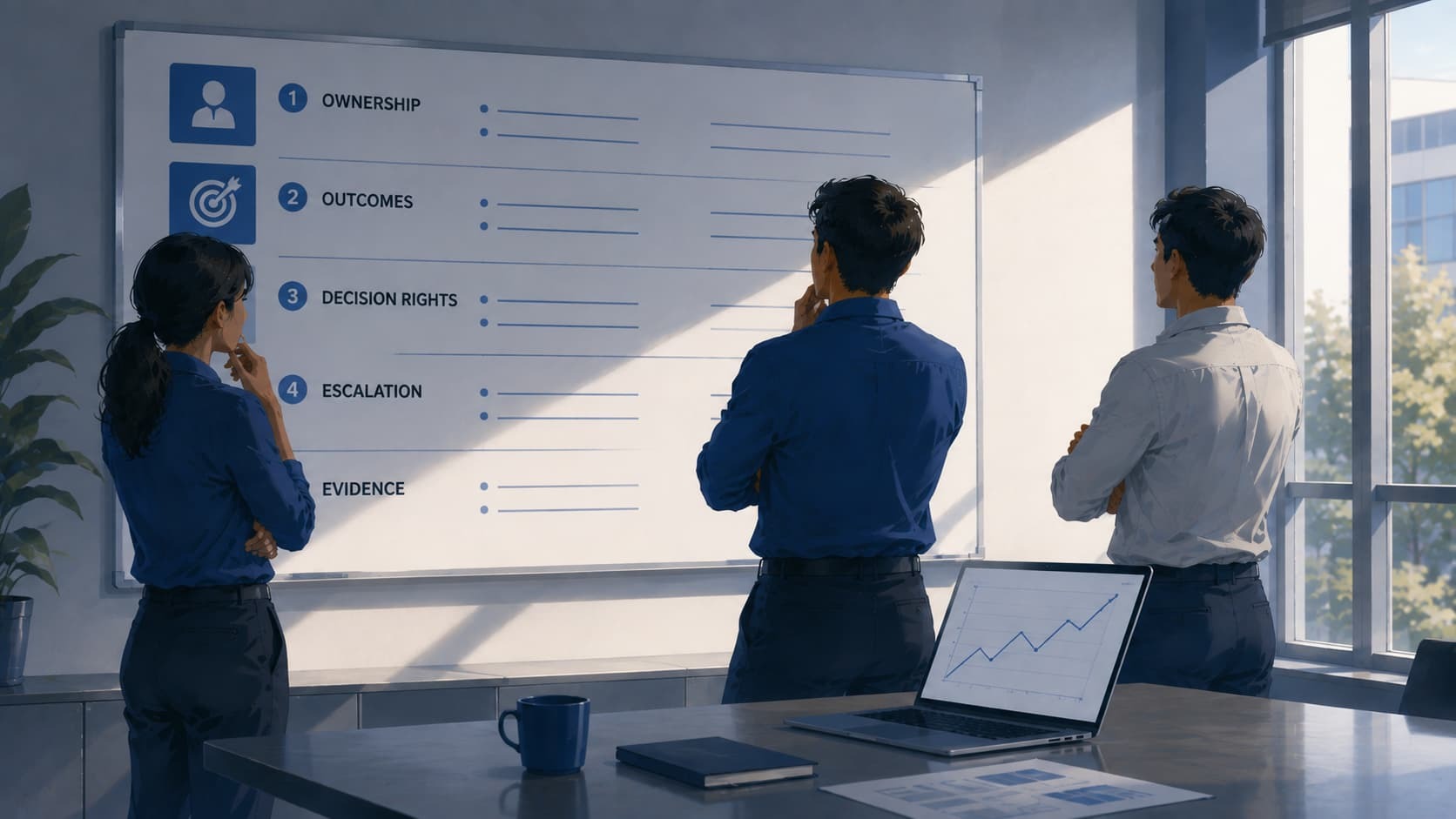
A gate, not a rubric
All five filled, or the pilot does not graduate. There is no score, there is no readiness percentage, and nothing gets ranked against anything else.
That was deliberate. A score lets you pass with a gap. Four strong sections and an empty escalation plan average out to something respectable, and the empty one is the one that finds you later.
Does not graduate means it keeps running as a pilot, with a pilot's budget and a pilot's blast radius. It does not mean you killed it. It means you stopped pretending it was ready.
Decision rights is the section that argues back
Section three asks who can change it, who can pause it, and who can kill it. Three answers, and names rather than titles, because a title survives a reorganization without anyone noticing that the person behind it has gone.
There is a number worth adding here, late and on purpose, because it is a signal rather than proof. The same KPMG survey of US-based leaders at billion-dollar organizations asked what triggers a decision to override an AI output. A third of them named case by case, with no formal criteria, as one of their triggers.
Three things travel with that number. The question is about overriding a model's output in a running system, not about pausing or killing a pilot, and those are different acts. The connection I am drawing between the two is mine, not KPMG's. And undecided criteria for the narrower intervention is a signal about the wider one rather than evidence of it.
There is a fourth thing, which is arithmetic. Leaders could pick more than one answer and the listed triggers total well past 100%, so that third is not a clean segment of organizations without criteria. A respondent could have selected formal thresholds and case by case both.
None of it proves the decision-rights section is empty anywhere. What it does is make me unwilling to assume the bigger question is settled when the smaller one about who can actually halt a system has never been written down.
The section people leave blank
My bet is escalation. It is the only one of the five that costs somebody their evening, and a name in section four is a promise about a night nobody has had yet.
Bain's From Pilots to Payoff chapter names five recurring roadblocks to scaling generative AI: lack of executive direction, adoption resistance, skills gaps, no ROI tracking, and process or tooling mismatch. That list is Bain's advisory judgment rather than a survey result. The chapter publishes no sample, no fielding window, and no population, so it carries no percentage here and should not be read as measurement.
Two of Bain's five, executive direction and ROI tracking, name the same failures that sections one and five ask about. That is worth knowing precisely because Bain sells the remedy, and it is also the reason to attribute the list to them out loud rather than absorb it. Naming a specific human as accountable for what ships is the move underneath both of them.
What anybody has actually measured about ownership
None of the above is proof of the argument I am making, and it is worth being exact about what comes closest. BCG's 2025 study The Widening AI Value Gap surveyed CxOs and senior executives who are AI decision makers. It sorts them into four maturity bands computed from a self-assessed score across 41 capabilities, so the bands are positions on BCG's own index rather than natural categories.
Among the companies BCG places in the top band of that index, 43% report equal responsibility for AI between business and IT, against 19% of the companies in its lowest band. BCG describes the top group as roughly 1.5 times more likely to have joint ownership, and reports more than 40% of them explicitly embedding shared ownership into governance with clear decision rights and shared accountability.
BCG, The Widening AI Value Gap (2025): the October 2025 PDF, with the maturity bands defined in its appendix
That is an association BCG observed at one point in time. It is not a mechanism, and the causal reading is mine. Ownership clarity and AI maturity occur together in that data, nothing in the study establishes which produced which, and both plausibly follow from a third thing, such as a company that is simply well run. BCG does not claim the direction of the arrow, and I am not going to borrow their credibility for it.
Try this next week. Pick one pilot you are proud of. Ask who runs it in production, by name. Then ask who can kill it. If either answer takes more than a few seconds, you have found the work, and what you have found is not a failure. If both answers come fast, you are further along than most of the conversations I get to have, so go scale it.
Demos are cheap. Operating capability is the whole game.
None of this is hard to write down. It is hard to agree on in a room, and harder to make normal afterward. If your teams need help building ownership and decision rights into how they actually work, that is what private training and coaching is built for.