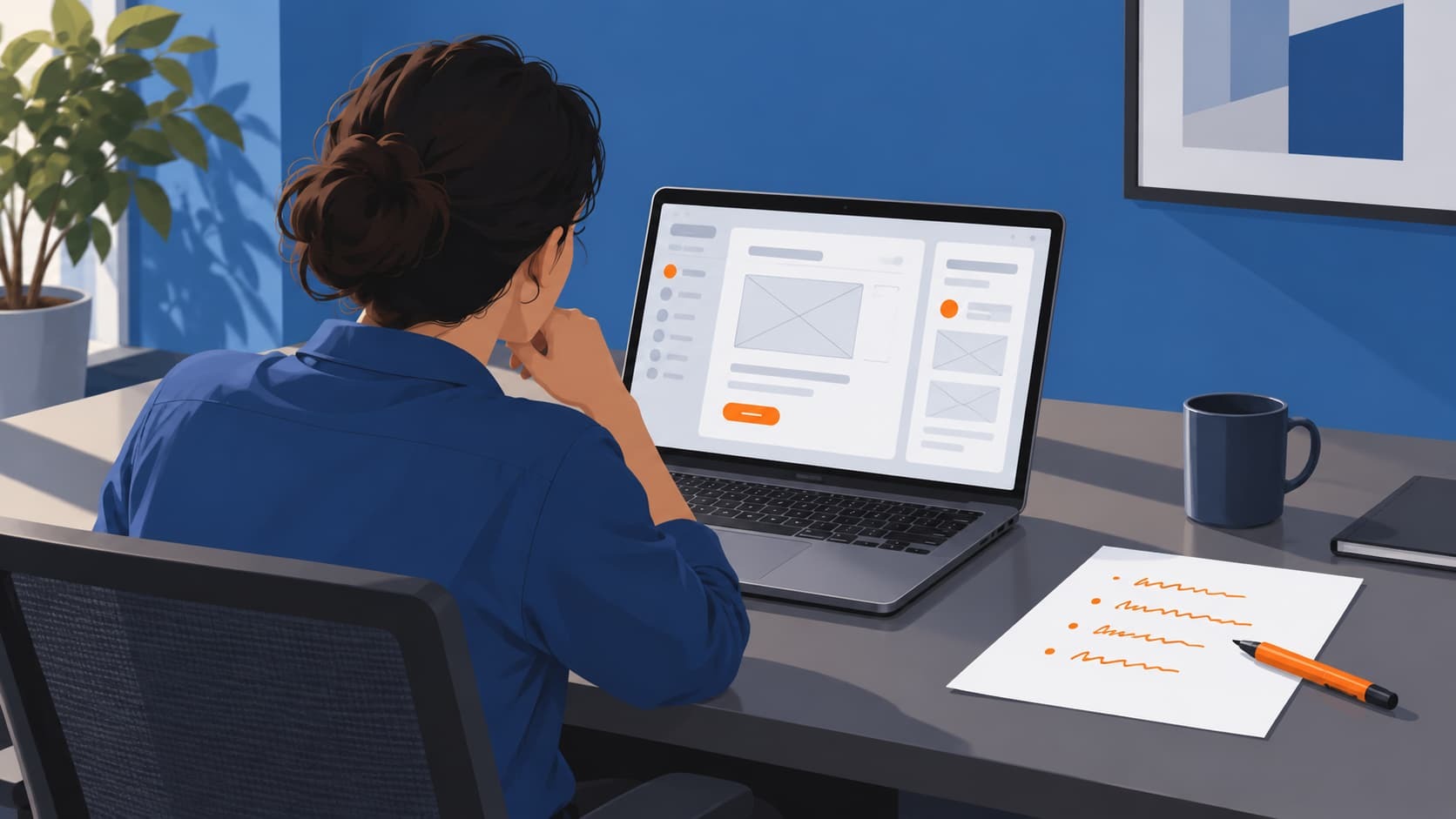
A year ago, a product manager spent Monday grooming the backlog. Today that same person can describe a feature out loud and have three working prototypes before lunch. So a loud camp has decided the role is finished, and a new one, the "product builder," takes its place. Something real is happening to the job, but what is leaving is not the same as what is dying.
What the product-builder prediction actually claims
The claim is that AI turns the product manager into someone who researches, prototypes, tests, and decides with a model in the loop, and that the coordinator role around all of that goes away. Whether that is evolution or replacement is an active debate, not a settled fact. The prediction is right that a chunk of the work is being automated. It slips when it treats the tasks and the role as the same thing.
The debate is not whether AI changes the work; anyone who has used it has settled that for themselves. The debate is whether what remains still needs a dedicated person, or whether an engineer with good taste and a model quietly absorbs it. That is a fair question, and the honest answer is that it depends on how much judgment the work actually demands.
The prediction is seductive because the before and after is real and visible. Anyone who has watched a model turn a sentence into a working screen has felt the ground move. The mistake is reading that as the whole job vanishing.
What moved was the cost of producing the artifacts: the specs, the mockups, the first cut of the analysis. The reason those artifacts ever existed, someone deciding what to build and standing behind it, did not move at all. The role was never the tasks. The tasks were how the role showed up when building software was slow and expensive.
What AI collapses, and what it does not
Start with what genuinely collapses. Research synthesis, first-draft specs, and clickable prototypes used to be a relay race between people. AI compresses that relay into one working session. These steps were slow because people were the bottleneck, not because the work was ever the hard part.
You can see it in the small things. Competitive research that used to take a week of reading now arrives as a synthesized brief in an afternoon. A first-draft spec that used to sit in a queue behind three other people writes itself while you refine the questions. None of that was ever the hard part; it was just the slow part, and losing it is worth reading about in why clear intent became a speed control once AI is doing the building.
Now watch what does not collapse. Say you are weighing a saved-views feature for a dashboard your biggest customer keeps asking for. AI can draft the spec, generate three prototype flows, and write the acceptance criteria in an afternoon. None of that tells you whether to ship any of them.
What it hands back is not an answer. It is three plausible options and a faster path to shipping the wrong one. Whether that customer is representative or just loud, which of the three flows fits how people actually work, and whether the feature should exist at all: those are still yours, and none of them got easier.
The failure mode to watch for
Here is how the shift goes wrong in practice. A team gets AI tools, the speed of producing specs and prototypes doubles, and the backlog doubles with it. Six months later they have shipped twice as much, and none of it moved the number that mattered.
The reason is simple: nobody's judgment got faster, only their output. That is the administrative version of the role surviving in a new form, the same busywork with more of it, now automated. The point of the shift is not to build more. It is to spend the time you get back deciding better, so the things you do build are the right ones.
The five capabilities that matter more now
The scarce skill is no longer building. It is deciding what is worth building, and every one of these five gets more valuable the moment execution stops being the constraint. The map is at the end of this section, to run on yourself. But the reason each one matters more now is worth walking first.
Judgment is deciding under uncertainty and owning the outcome. When you could ship one bet a quarter, you made a handful of real calls a year. When you can ship one a week, you make dozens, and every one still lands on you. The hard part was never generating the options; it is choosing among them with your name on the result.
Owning a decision is not the same as making it alone. You gather the evidence, you hear the room, and then you are the one who says what gets built and why. The volume of those calls went up, the person accountable for them did not change, and a wrong one is still yours to answer for. That is the job getting harder, not disappearing.
Evidence is designing the test that would change your mind, not the one that confirms the plan you already like. Cheap building is a standing temptation to skip the test and just ship, because shipping is now the easy part. The guard is a disconfirming test, sized so it can actually teach you something. Keeping that test small without giving up the ambition is its own discipline, covered in shrinking a bet without shrinking the goal.
Tradeoff-making is saying no on purpose. When building was expensive, the backlog policed itself, because you could not afford most of it. Now you can afford to build almost anything, so the backlog fills with things that are cheap to make and expensive to own. Every feature you add is a promise to maintain it forever, and when the making got cheap the maintaining did not, so saying no became the scarce act.
Prototyping changed shape rather than value. The question stopped being whether you can build it and became whether you can build the right small thing to learn from. A prototype is a question you can click, and a good one is aimed at the riskiest assumption you hold. AI makes three prototypes trivial, so the speed is a gift only when you point it at the thing you are least sure of.
AI fluency is the literacy underneath all of it: knowing when to trust the output and when to verify it. A model is most dangerous when it is confidently wrong, because it is fast and it sounds right. Reading an output for what it actually says, and noticing when your gut disagrees for a reason, is a skill you build on purpose. The three-question test is one way to practice it.
THE PRODUCT BUILDER CAPABILITY MAP
Run this on yourself. Score each area 1 to 5, honestly.
1. JUDGMENT
   Deciding under uncertainty, and owning the call.
   Score (1-5): ___
2. EVIDENCE
   Designing the test that would change your mind.
   Score (1-5): ___
3. PROTOTYPING
   Building just enough to learn, now AI-accelerated.
   Score (1-5): ___
4. AI FLUENCY
   Knowing when to trust output and when to verify.
   Score (1-5): ___
5. TRADEOFF-MAKING
   Saying no on purpose, and defending the no.
   Score (1-5): ___
DONE WHEN: you can name your lowest area and the one
habit you will change this month to raise it.
Worked once through: a PdM scores Prototyping a 4, because
AI made it easy, but Evidence a 2, because they rarely
design a test that could prove them wrong. The low score is
the useful one. It says the next month goes to building a
disconfirming test, not to faster prototypes.If two areas fight for your attention, start with evidence and tradeoff-making, because that is where speed does the most damage. When you can ship more bets, a weak test or a soft no costs more than it used to, since you act on it faster. Those two are where your attention pays off most.
Try this next week
Take one thing on your plate that AI now does for you: a spec, a prototype, a first-pass analysis. Let it do that thing. Then write down the judgment call that the speed just put in front of you sooner.
Name one task AI changed for you, and one it could not touch. The second list is the job; the first was always overhead. Score yourself on the map before your next planning session, and bring your lowest area to it.
If your team is making that shift and you want the product-ownership fundamentals under it to be solid, our Certified Scrum Product Owner class is built for exactly this moment.