
The way product leaders tell the last year goes something like this: our product people got time back, so they have more room for strategy. The calendars seem to agree. They are full of roadmap reviews, prioritization syncs and stakeholder readouts, and every one of them has a strategic-sounding name. So ask who that time faces: the people inside your building, or the customers and buyers outside it.
Where the reclaimed time went
Start with what Pragmatic Institute measured. In Pragmatic Institute's State of Product Teams Report 2025, 47% of respondents say they are spending more time on strategic activities than last year; 28% say the same amount and 24% less. That is one retrospective question in one survey, and the report never defines what counts as strategic. So "product teams got time back" describes fewer than half of the people who answered, not the whole field.
Then the report draws its conclusion. It says much of the strategy time product teams reclaimed is absorbed by coordination and internal alignment rather than market learning or decision clarity. That is Pragmatic's reading of its own data, built from separate measures, not a measured split of anyone's week. And by product teams it means the whole product org, product management and product marketing together, not product managers alone.
The measures underneath it are worth reading in their own terms. In the same report, 46% of respondents say they spend more than 20 hours a month managing meetings and internal communication. In the same report, 53% of respondents say they spend less than 5 hours a month on customer interviews, win/loss analysis or interviewing potential buyers.
Both figures are shares of people above or below a line, never a share of anyone's time, and neither is compared with last year. The customer figure counts those three activities only, so support calls, sales calls and usability sessions are not in it. The report calls these hours calendar data without saying how they were collected, so the numbers cannot show time moving from customers to meetings. They are still a fair snapshot of where respondents' hours sat, and that is enough to make the question worth checking in your own building.
One more thing before you lean on any of it. Pragmatic sells product management training, and the report recommends its own courses. It publishes no sample size, no fielding dates and no survey method, so hold every figure here loosely.
Pragmatic Institute, State of Product Teams Report 2025 (vendor-published): the report page, where the PDF is offered
Alignment is there to carry what you learned
None of this makes coordination the villain. A product team that can't agree can't ship anything, and a product manager who keeps everyone informed is doing real work. Alignment is there to carry what you learned outside the building to the people inside it, so they can decide how to spend the team's capacity. When the calendar holds only alignment, there is nothing to carry, and every meeting recirculates what the room already thought.
What follows is Big Agile's argument, not a finding of Pragmatic's. When internal consensus stands in for external validation, the room agrees and nobody checks the market. Agreement tells you the people in your building believe the same thing. It doesn't tell you a customer will use what you build, or how they will respond to it.
The report has a related figure on how priorities get set. In the same report, executive mandate is the most common real-world prioritization driver, named by 28% of respondents. Market evidence models come in at 15%. The most common answer is still a minority answer, but the top driver comes from inside the building, not from the market.
That is where speed gets dangerous. If agreement is standing in for evidence, a faster team doesn't fix anything; it builds the wrong thing sooner. We made a related case about unclear intent in AI-assisted delivery: the cheaper building gets, the more an unchecked assumption costs.
The answer is not another meeting about the meeting. It is putting the hypothesis in front of a customer before the team spends weeks building. That is why you shrink a bet until you can test it cheaply and ask how much of your roadmap rests on evidence. Hypothesis testing is part of what we teach in the Certified Scrum Product Owner class.
The Discovery Displacement Audit
You can't correct a drift you can't see, so the first job is seeing where one week of product time actually went. The Discovery Displacement Audit is Big Agile's one-page worksheet for that. Run it on last week's calendar, yours or one product person's on your team, and sort every block by who the time faces.
There are three columns, defined by audience rather than quality. Market-facing is time with customers, buyers or market data. Delivery-facing is time with the team building the product, and it is valuable work. Internal alignment is time spent getting people inside the building to agree.
Sort by who the time faces, not by whether the meeting was any good; that is a different question. A great alignment meeting still goes in the alignment column. Then write down the split your team intends before you total anything, because the intended split is the team's stated priority, and it has to exist before the week is measured against it.
THE DISCOVERY DISPLACEMENT AUDIT
One week of one product person's calendar. One page.
WEEK OF: ___________  WHOSE CALENDAR: ______________
1. TAKE LAST WEEK'S CALENDAR
   Yours, or one product person's on your team.
   Total hours booked: ________
2. SORT EVERY BLOCK BY WHO THE TIME FACES
   Not by whether the meeting was any good.
   MARKET-FACING: customers, buyers, market data.
   ____________________________________________
   DELIVERY-FACING: the team building the product.
   ____________________________________________
   INTERNAL ALIGNMENT: getting people inside the
     building to agree.
   ____________________________________________
3. WRITE THE INTENDED SPLIT, BEFORE ANY TOTALS
   How many hours should face each column?
   Market-facing intended: ________
   Delivery-facing intended: ________
   Internal alignment intended: ________
4. TOTAL THE COLUMNS AND SET THEM BESIDE IT
   Market-facing logged: ________
   Delivery-facing logged: ________
   Internal alignment logged: ________
   Intended minus logged is the drift.
   Market-facing drift: ________ hours
DONE WHEN: every block sits in one column, the
intended split came before the totals, and the
market-facing drift is one number. It describes
how the week faced, not how hard anyone worked.
Total the columns and set each beside the intended split. The gap between the two is the drift, and it is about how the week faced, not how hard anyone worked. One week won't tell you everything, and it is certainly not a trend; it tells you whether the priorities your team states show up on the calendar at all.
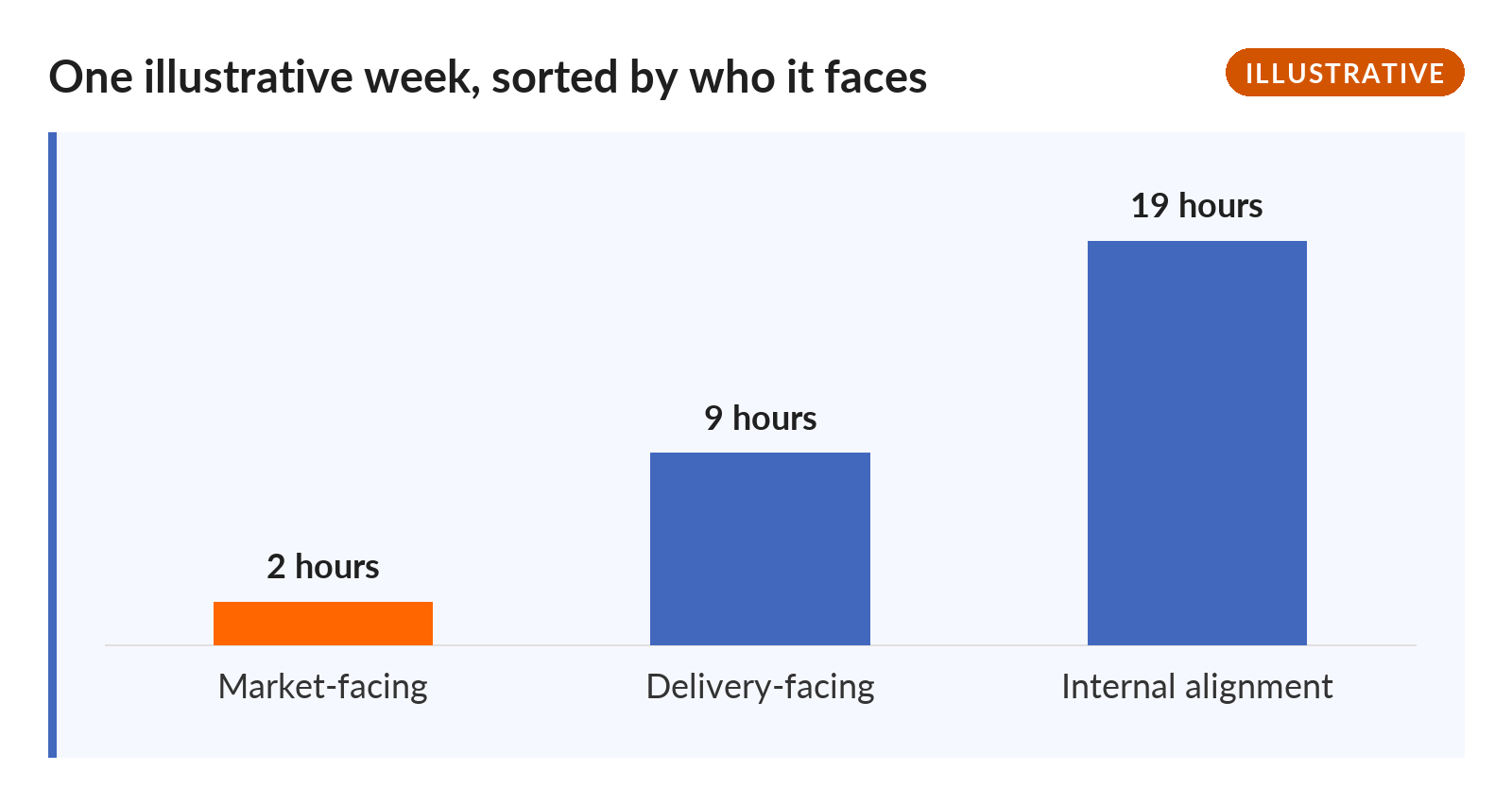
An illustrative week: of 30 booked hours, 2 faced the market. The team intended 10.
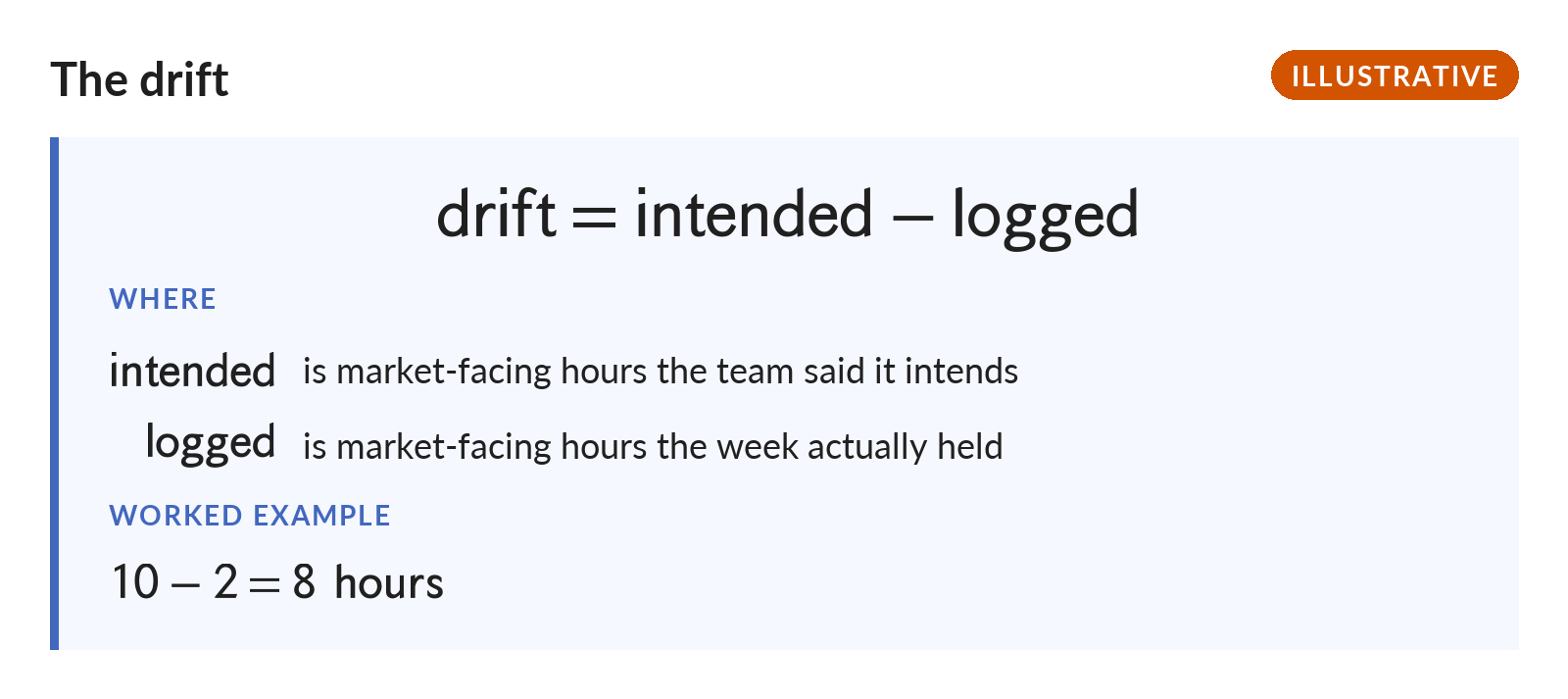
The illustrative week's drift. It describes how the week faced, not how hard anyone worked.
The worked example below runs the audit on that same illustrative week, so you can see each step filled in before you try it on your own calendar.
ILLUSTRATIVE EXAMPLE. FICTIONAL.
One product manager's week: 30 hours booked.
INTENDED SPLIT
  A third of the week facing the market,
  10 of 30 hours. Written before the totals.
MARKET-FACING: 2 hours
  One customer call and a skim of the support
  queue.
DELIVERY-FACING: 9 hours
  Refinement, sprint reviews, questions from
  the developers.
INTERNAL ALIGNMENT: 19 hours
  Monday roadmap review, Tuesday prioritization
  sync, Wednesday pre-meeting, Thursday
  stakeholder readout.
MARKET-FACING DRIFT: 8 hours
  10 intended, 2 logged. Every alignment hour
was about customers; none had a customer in it.Protect the slot, and name who decides it
Seeing the drift doesn't close it. The structural fix is small: whatever time your intended split gives the market is a slot, and the slot has one named owner. Then name who decides when an internal meeting can take that time, and make it someone who answers for what the team learns, not for how many people agreed.
That decision belongs above the product manager. In the illustrative week, the roadmap review, the prioritization sync and the stakeholder readout are leadership's meetings, so protecting the market-facing block is a call I'd put with whoever owns them. A product manager defending an hour of customer time against a meeting her leader called is arguing uphill.
This section leaves out, on purpose, how often to talk to customers and what those conversations look like. That is a practice, and it deserves its own treatment. The goal here is narrower: make the market-facing time visible, give it an owner, and make taking it a decision someone has to make out loud. If you want the wider operating model behind that, we laid out a learning model alongside the delivery model.
Try this next week
Pull last week's calendar for one product person, sort every block, write the intended split, and total the columns. Then bring one question to your next roadmap review. What did we learn from a customer that changed this particular item that we're talking about? If nobody can answer, the item isn't validated; it's agreed.
If you run it again on a later week, read that week the same way. One week is a snapshot, and whether a number moved is a different question from whether anything actually changed.
If the drift is bigger than you can explain to your leadership team, send me a note if you need help.