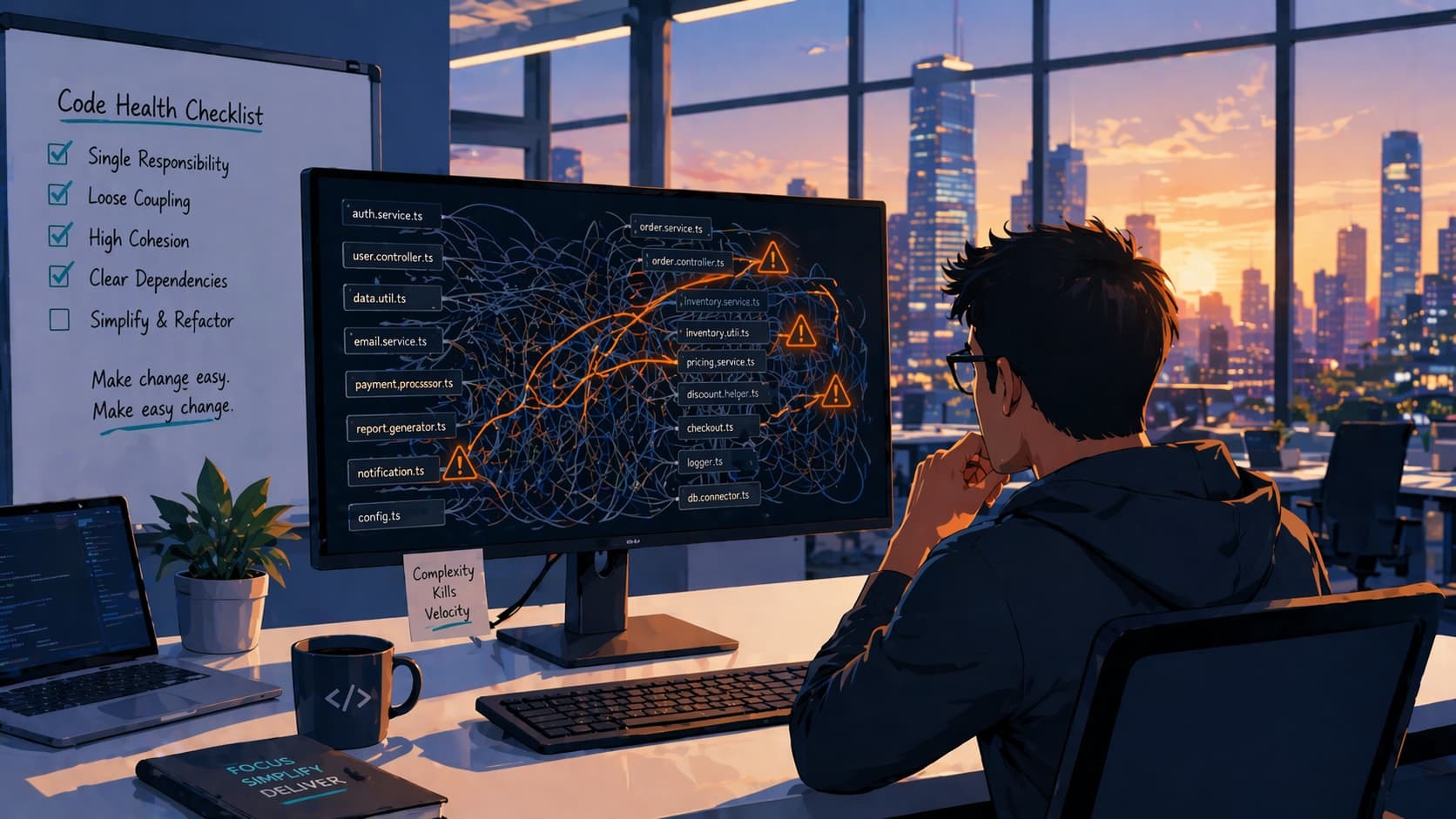
Your team's velocity is the highest it has ever been. Features are shipping faster than the roadmap can absorb them. And somewhere around month three, everything is going to slow to a crawl, and nobody will be able to explain why.
I keep seeing this pattern. The quarterly metrics look incredible. Deployment frequency is up. Cycle time is down. Leadership is thrilled. Then the team starts spending 60 percent of their sprint capacity fixing things that broke, and the conversation shifts from "how do we ship faster" to "what happened to us."
What happened is a phenomenon called vibe coding. And before you dismiss it as a developer buzzword, understand this: it is reshaping how your product gets built whether you know it or not.
What vibe coding actually is (in plain language)
The term was coined by Andrej Karpathy, co-founder of OpenAI, in February 2025. He described it as a style of AI-assisted development where you "fully give in to the vibes, embrace exponentials, and forget that the code even exists." You describe what you want in plain language, accept the AI's output without deeply reviewing it, and move on. When something breaks, you paste the error back in and hope for the best.
Karpathy intended this for throwaway weekend projects. Collins Dictionary named it the Word of the Year for 2025. By early 2026, 41 percent of commercial code was AI-generated, and the practice had moved well beyond weekend experiments into production codebases at scale.
The real benefits are real (and that is what makes this tricky)
I want to be clear: this is not an anti-AI argument. AI coding tools have legitimate, measurable benefits. They accelerate prototyping. They make software development more accessible. They help experienced engineers move faster on boilerplate work. These gains are real, and I see them in the organizations I coach.
The problem is not the tool. The problem is the absence of governance around the tool. A team using AI to accelerate well-structured work with proper review is in great shape. A team accepting AI-generated code without architectural scrutiny is building on sand. The difference between those two scenarios is not the AI. It is the team's Definition of Done.
The spaghetti point: what month three looks like
Baytech Consulting documented a pattern they call the "Spaghetti Point," the moment where the initial velocity gains from vibe coding collapse under the weight of accumulated complexity. Their research found that while vibe-coded projects appear faster in the first weeks, the crossing point typically occurs around month three. At that stage, adding new features starts breaking existing ones. Velocity drops to near zero as the team spends all their time fighting fires.
This matches what I hear from engineering leaders in coaching conversations. The first sprint felt magical. The second sprint felt fast. By the third month, the team was drowning in rework and nobody could trace the root cause because the code had grown beyond anyone's comprehension. The architecture was never intentional; it was emergent from thousands of AI suggestions, and emergent architecture without human judgment is just entropy with better formatting.
The documented risks in product terms
Beyond the velocity collapse, the research paints a specific picture of what vibe coding leaves behind.
Security vulnerabilities multiply
CodeRabbit's December 2025 analysis of 470 pull requests found AI-generated code introduces 1.7 times more defects overall and is 2.74 times more likely to contain cross-site scripting vulnerabilities. Veracode tested over 100 large language models and found 45 percent of AI-generated code contained security vulnerabilities. For product leaders, this is not a developer concern. It is a customer trust, regulatory, and liability concern. If your team cannot tell you what percentage of your codebase is AI-generated, you cannot assess your security exposure. You are relying on hope, and hope is not a metric.
Institutional code knowledge erodes
When AI writes code and humans accept it without understanding it, the team loses something that no tool can replace: shared knowledge of why the system works the way it does. Researchers have started calling this "cognitive debt," the systematic erosion of human understanding when AI writes code on your behalf. Unlike technical debt, which lives in the code and can be refactored, cognitive debt lives in people's minds. Once a team has lost its shared understanding of a system, the only way to repay it is to re-read and re-comprehend the entire codebase. That is often more expensive than rewriting it. This connects directly to digital provenance, the ability to trace where your code came from and who (or what) made each decision.
The maintainability gap compounds quietly
Forrester predicts that 75 percent of technology decision-makers will face moderate-to-severe technical debt by 2026. We are in 2026. That prediction is not about the future anymore. AI-generated code tends to create hyper-specific, single-use solutions instead of reusable components. It avoids refactoring existing architecture, preferring to write new code that works around existing structure rather than improving it. Over time, the codebase balloons with near-duplicate functions, and every change introduces risk because nobody fully understands the dependency chain.
A practical governance checklist (add this to your Definition of Done)
This is not about slowing teams down. It is about making the invisible visible so you can manage risk proportionally. If your organization has adopted AI coding tools, consider adding the following to your team's Definition of Done. These are not bureaucratic gates. They are minimum quality standards for a new kind of input, and they align with minimal viable governance principles.
1. Tag every pull request by origin. Mark each PR as AI-generated, AI-assisted, or human-authored. This creates a baseline. You cannot govern what you cannot see.
2. Require architectural review for security-sensitive AI code. Any AI-generated code touching authentication, authorization, data handling, or infrastructure needs review by an engineer with system context, not just a standard code review pass.
3. Run additional static analysis on AI-generated PRs. Use SAST tools and security linters as a first pass before human review. Let automation catch the patterns AI gets wrong most often so your reviewers can focus on intent and architecture.
4. Add explicit edge case verification. AI-generated code handles the happy path well and misses edge cases consistently. Your Definition of Done should require documented edge case coverage for AI-generated work.
5. Track the ratio of new feature work to rework. If your teams are spending more capacity fixing things than building things, the AI tools are not making you faster. They are making you feel faster while eroding delivery health.
6. Ask one question in every sprint review. "What percentage of this sprint's code was AI-generated, and what percentage of that was human-reviewed by someone who understands the system?" If the team cannot answer, start there.
Common traps (and what to do instead)
Trap: treating all code the same regardless of origin. It sounds fair, but it ignores the data. AI-generated code has different failure patterns than human code. Same process for a different risk profile is not equitable. It is blind. Instead, apply tiered review standards based on risk level: lightweight review for AI-assisted boilerplate, full architectural review for anything security-sensitive or customer-facing.
Trap: measuring AI success by adoption rate. The question "how many developers are using AI tools" tells you nothing about quality. Instead, pair adoption metrics with delivery health metrics. Deployment frequency alongside change failure rate. Output volume alongside rework ratio. Speed without stability is not velocity; it is turbulence.
Trap: assuming "it passed the tests" means "it is production-ready." AI-generated code passes tests because AI is excellent at generating code that satisfies test conditions. But test coverage and code quality are not the same thing. Code can pass every test and still be architecturally unsound, unmaintainable, or insecure in ways the tests do not cover.
Try this next week
Ask your team to tag every pull request as AI-generated, AI-assisted, or human-authored for the next two sprints. Just tag it. Do not change the process yet. Do not add gates. Just make the invisible visible.
Why this works: it creates a baseline without friction. Once you can see the data, you can have an informed conversation about whether your quality process needs to adjust. Most teams discover that 30 to 50 percent of their code is now AI-generated, and they had no idea. That awareness alone changes behavior.
The next step after that: pull your change failure rate and time-to-restore data for the same period. Compare the trends. If AI adoption went up and delivery stability held, your team is managing this well. If both went up, you have found the gap that needs attention. If you are navigating this transition and want hands-on support, our AI for Product Management workshop is built for exactly this conversation.
Vibe coding is not going away. The tools will keep getting better. The volume of AI-generated code will keep growing. The question for product leaders is not whether to adopt, but whether to govern. The organizations that win in the next two years will not be the ones that generated the most code. They will be the ones that generated the right code and maintained the discipline to verify it.
This is not anti-AI. It is pro-sustainability.
If "governance will slow us down" is the objection you are hearing, this post gives you the counter-argument and the practical framework to prove it wrong.