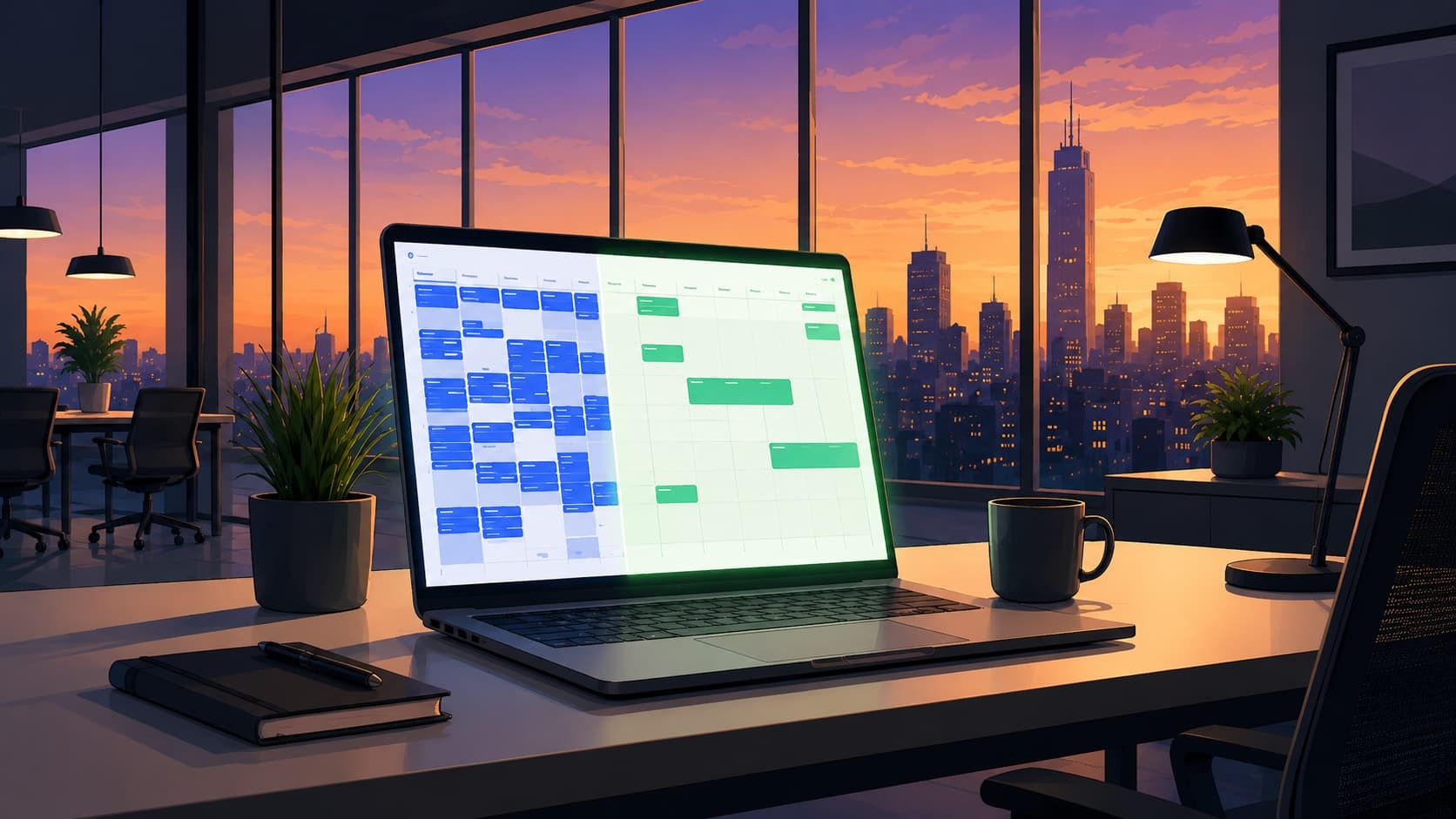
A product manager I coach pulled up her calendar last Friday and pointed at something she had circled in red. Eleven hours of refinement, estimation, and backlog grooming. Three hours of actual user conversation. She looked at me, half tired and half angry with herself, and said, "I'm spending my week getting better at planning the work, not at planning the right work. And my engineers are starting to outpace me."
That sentence is the entire 2026 PM problem in one breath.
The ratio that used to be defensible
That calendar used to be fine. When code took weeks to ship, refinement and estimation were where the team caught misalignment before it became expensive rework. When you could afford to be wrong for a sprint, the value of pre-build conversation was high enough to justify a whole week of pre-build conversation.
Now your engineers can prototype in hours. British computer scientist Andrew Ng has talked publicly about teams where projects that used to take six engineers three months get built on a weekend. When build time collapses like that, the cost of being wrong about what to build moves earlier in the cycle. The constraint moves. And if the PM job does not move with it, the team starts to outrun the person who is supposed to point at where to go.
The judgment did not change. The time allocation did.
This is the part most takes on AI changing the PM job get wrong. They pitch this as total disruption, a new kind of professional showing up to replace the old one. That is not what is happening.
What is happening is an inversion of how your time should be allocated. The same skills still matter. The same hard calls still need to be made. The clock just moved on which of them needs the largest share of your week.
Roman Pichler has been writing about outcome-based product ownership for over a decade. The argument is that a product owner's job is to be accountable for outcomes, not artifacts. That argument is twenty years old in product circles. It is now urgent rather than aspirational, because the artifact production speed of the engineering team has stopped being the bottleneck.
(Roman Pichler, "Outcome-Based Product Management")
A day in the life: the traditional PM week vs. the 2026 PM week
The traditional PM week
On a typical week three years ago, you spent about six hours in backlog refinement and estimation, four hours in sprint events, six hours in stakeholder and roadmap conversations, four hours in user research and discovery, and the rest of the week writing tickets, answering Slack, and following up on delivery questions. About 60% of your week went toward helping the team get the next sprint right. About 40% went toward figuring out what should be in future sprints at all.
That ratio worked because the team's ability to translate decisions into shipped code was the bottleneck. If you got the spec wrong, you paid for it for two weeks. The spec deserved the time.
The 2026 PM week
On a typical week now, the calendar should look almost inverted. Six to eight hours in direct user conversations, recorded or live. Three to four hours reviewing outcome evidence and adjusting the next bet. Four hours in stakeholder conversations focused on what to stop, not what to start. Two to three hours in refinement and ceremonies. The rest of the week in synthesis, writing, and decisions.
The estimation ceremonies in particular should shrink. When AI tooling is moving the build-time variance for many tasks toward "we can find out by lunch," story points and predictability ceremonies start losing signal. There is more on the second-order effects on engineering metrics in our recent post on measuring AI's real impact on your delivery flow.
What changes, and what does not
The work that moves toward the front of your week is user conversation, outcome measurement, and the small experiments that test whether you are right about something. This is where the time you used to spend refining stories should now go. Our post on signal vs. noise in product metrics is a good place to anchor what outcome evidence actually looks like in practice.
The work that does not change is the harder, less visible part of the job. The judgment about which problems are worth solving did not move. The relationship work with stakeholders, the negotiation, the long-arc strategic context, none of it became less important. The prioritization under genuine constraint, between two things that both seem worth doing, still requires the same product brain it always required.
What did change is that you now have fewer excuses to be busy with planning the work as a substitute for doing the actual product job.
Three traps worth naming
The first trap is letting estimation ceremonies expand to fill the time you save. The default move when the engineers get faster is to refine harder, to estimate more carefully, to plan more sprints out. That is the wrong direction. The signal value of story points goes down as build-time variance compresses, not up.
The second trap is treating discovery as a phase that happens before sprints, rather than as the operating mode of the team. If your team thinks discovery is the thing that happens before you start building, your team is not yet operating in the world it is actually in.
The third trap is becoming a high-functioning feature trafficker. Smart, fast, organized, and still optimizing the wrong thing. If your week is full and your stakeholders are happy and your outcomes have not moved, you have built the wrong job around yourself.
Try this next week
Open your calendar for next week. Find one recurring planning or refinement event that takes more than 60 minutes. Cut it in half, or move half of it to async. Not delete. Cut.
Then do one more thing. Block three 90-minute slots labeled "outcome conversation." Schedule them before you have someone to talk to. The slot will create the pressure to find someone, and that pressure is exactly the muscle this shift is asking you to build.
Two weeks of that, and the calendar starts to tell a different story about what your job actually is.
If you want a deeper walkthrough of this shift, including how to evolve your PO toolkit when AI is changing your team's delivery rhythm, our AI for Product Owners workshop spends a full day on exactly this question.
From Delivery to Learning: A Practical Operating Model for 2026
If this week's piece resonated, the operating-model view is the natural next read. Most product teams have a delivery model. Very few have a learning model. That gap is what determines who adapts fast enough to matter.